ADVERTISING DISCLOSURE: THIS POST CONTAINS AFFILIATE LINKS. READ FULL DISCLAIMER
Last updated: May 2026
Quick verdict: Culture Amp is the category leader in employee engagement surveys, with research-backed templates, the largest engagement benchmark dataset in the market, and a connected Perform and Develop suite that can replace standalone review tools. It is best suited to mid-market and enterprise HR teams of roughly 200 to 5,000+ employees with budget for a six- to mid-five-figure annual contract. It is generally not the right fit for teams under about 100 employees, where pricing per head climbs sharply and lighter-weight alternatives tend to make more sense.
What Culture Amp is
Culture Amp is an employee experience platform that combines engagement surveys, performance management, and employee development into a single connected suite. The company describes itself as the global leader in employee experience and reports that more than 6,800 companies use the platform, including Canva, McDonald’s, Etsy, Airbnb, and Pinterest. The product is organized into three core modules that can be purchased individually or bundled: Engage (surveys, retention insights, action planning), Perform (goals, reviews, 1-on-1s, calibration, 360 feedback), and Develop (career paths, growth goals, competency frameworks).
What separates Culture Amp from the rest of the engagement-tool market is its data position. The company says it has collected over 1.5 billion survey responses, which feeds the largest engagement benchmark database available. For HR leaders who want to compare their results against thousands of peer companies by industry, size, and region, that benchmark depth is hard to replicate elsewhere. The platform also leans heavily on its in-house People Science team, which builds the survey templates, validates the analytics, and on higher-tier plans provides direct strategic support to customer HR teams.
Culture Amp targets HR professionals, people leaders, and executive teams who want to run a structured listening program tied to performance and development outcomes. The typical buyer is an HR director or VP of People at a company between 200 and 5,000 employees, replacing a patchwork of SurveyMonkey, spreadsheets, and a separate review tool with a single integrated system.
Pricing and what teams actually pay
Culture Amp does not publish pricing on its website. Every quote is custom and depends on three variables: employee count, which modules you license (Engage, Perform, Develop, or some combination), and which service tier you select. All contracts are billed annually.
Based on procurement data, reseller benchmarks, and published industry analysis, here is roughly what teams report paying in 2026:
- Small teams (15 to 75 employees): Roughly $4,500 to $9,000 per year for Engage-only. The cost-per-head is high at the very bottom of that range, and Culture Amp sales reps generally steer smaller teams toward larger packages or recommend waiting until headcount grows.
- Mid-market (200 to 500 employees): Procurement data suggests around $20,000 to $35,000 per year for Engage, with bundled Engage plus Perform contracts typically running $30,000 to $55,000.
- Enterprise (1,000+ employees): Reported contracts commonly land in the $40,000 to $80,000+ range for the full suite, with multi-module enterprise deals at large companies going higher.
Per-employee math typically lands somewhere between $5 and $14 per employee per month, depending on tier, modules, and contract length. Multi-year commitments (two to three years) can unlock 15 to 25 percent lower annual pricing, and Culture Amp’s fiscal year ends in June, so buyers negotiating in April through June often have more leverage as reps work toward quarter-end and year-end targets.
Several cost drivers do not show up in the headline per-employee figure. HRIS integration setup can carry one-time configuration fees, particularly for Workday and SAP SuccessFactors. Renewal contracts commonly include 3 to 7 percent annual price escalators, which buyers should try to cap during initial negotiation. Some contracts also include limits on survey frequency, so HR teams running aggressive pulse cadences should confirm whether additional cycles incur extra cost. The Develop module is sold as an add-on rather than standalone, and People Science Plus (advanced strategic support) is a separate add-on as well. Pricing and quotes can change, so confirm current terms directly with Culture Amp.
Where Culture Amp stands out
Engagement survey depth and benchmarking
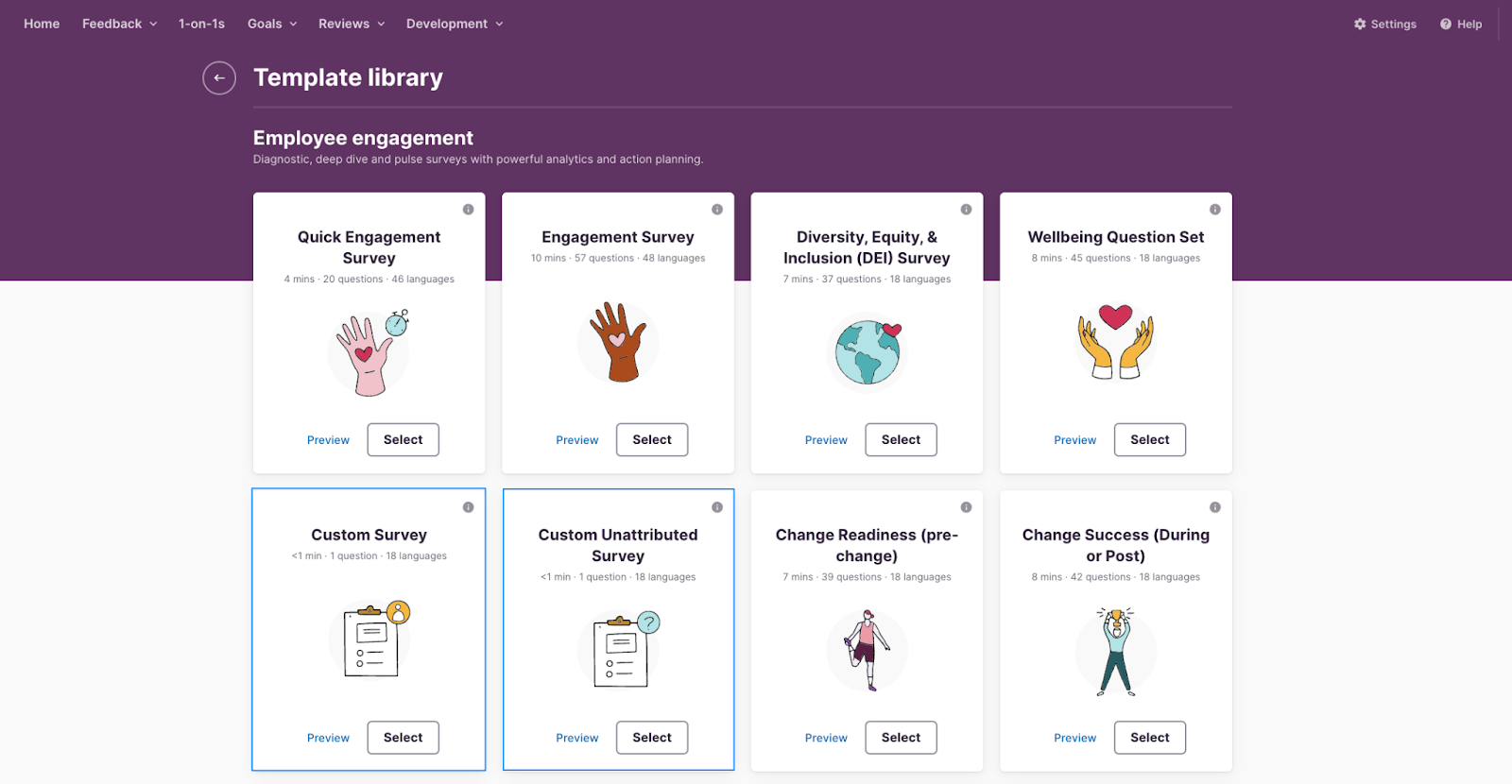
This is the core strength and the reason most teams buy Culture Amp. The Engage module ships with more than 40 science-backed survey templates covering engagement, onboarding, exit, diversity and inclusion, manager effectiveness, and wellbeing. The benchmarking data is the headline differentiator: the platform compares your results against thousands of peer companies, segmented by industry, region, and company size. An HR leader can frame a 68 percent engagement score with credible context about whether that is above or below similar organizations. Lattice, 15Five, and most other competitors have benchmark data, but none come close to Culture Amp’s depth.
People Science as an embedded function
Culture Amp’s People Science team is an unusually visible part of the product experience. The team includes organizational psychologists who build the survey templates, validate the analytics, and on higher-tier plans work directly with customer HR teams on survey design, results interpretation, and action planning. For HR leaders who do not have an internal industrial-organizational psychologist on staff, this support is genuinely useful and is one of the harder things for competitors to copy.
AI-assisted insights and manager tooling
The 2025 and 2026 platform updates introduced AI Coach, which surfaces focus areas from engagement survey data, helps managers prepare for difficult conversations through guided role play, and assists with drafting balanced performance reviews. The platform also handles automated comment theming, which turns thousands of open-text survey responses into prioritized themes without requiring HR to manually code them. For mid-sized HR teams that historically had to spend days reading comments, this is a meaningful time saver.
Connected suite that ties engagement to performance and development
The strategic argument for Culture Amp is that engagement, performance, and development data live in one platform. An HR leader can see, for example, that managers with low engagement scores from direct reports also tend to receive lower 360 feedback or have higher attrition risk. This connected view is hard to replicate when those workflows are split across three vendors. The Engage plus Perform combination tends to be where this story actually delivers.
Integrations with major HRIS and collaboration tools
Culture Amp offers native HRIS integrations with Workday, BambooHR, ADP Workforce Now, SAP SuccessFactors, Dayforce, Paylocity, Gusto, HiBob, Personio, Namely, UKG Pro, Paycor, Paychex, Justworks, Deel, TriNet, and roughly a dozen others, plus SFTP for any HRIS not on the native list. Slack and Microsoft Teams integrations push surveys, recognition, and 1-on-1 prompts into existing communication channels. SSO is supported via SAML and Google.
Where Culture Amp falls short
Pricing and fit for small teams
If your company has fewer than 100 employees, Culture Amp is generally not the right tool. The minimum contract value, the implementation overhead, and the per-employee math all break against you at small scale. Sales reps frequently steer small teams toward larger packages or recommend revisiting the conversation when headcount grows. For SMBs that want professional engagement measurement without enterprise pricing, lighter-weight options like Officevibe (now Workleap), 15Five Engage, or freemium tools tend to be a better starting point.
Customization limits
The most consistent criticism in user reviews is that Culture Amp does not allow as much customization as some HR teams want. Reviewers describe wanting to drill into results in ways the reporting tool does not support, or to modify standard workflows that are deliberately locked down. The platform’s design philosophy is opinionated: People Science has decided what good looks like and the product reflects that. For HR teams that want highly bespoke surveys, custom workflows, or unusual reporting cuts, this rigidity can become a friction point.
Performance management is competent but not category-leading
Culture Amp’s Perform module covers the fundamentals well: review cycles, goals, 1-on-1s, 360 feedback, and calibration. It is a credible product. But buyers who prioritize performance management often find that Lattice has deeper OKR cascading, more granular goal alignment, and tighter compensation integration, while 15Five has stronger continuous-feedback workflows and manager coaching tools. Teams that bought Culture Amp primarily for engagement and tried to layer Perform on top sometimes report that the performance side feels secondary to the survey core.
Support tier matters more than buyers expect
Several reviewers note that customer support quality varies meaningfully by service tier. Smaller customers on basic support packages report slow response times and a sense that they are not prioritized. Higher-tier customers with named People Scientist support generally describe the experience very differently. Buyers should ask explicitly during sales conversations what support is included at their proposed contract size, and budget accordingly if they expect to need responsive help during their first survey cycle.
Who Culture Amp is for
Culture Amp generally fits best when several of the following are true:
- Headcount is between roughly 200 and 5,000+ employees
- HR or People Operations is a real function with at least one dedicated owner
- Leadership wants engagement and culture made measurable and tied to business outcomes
- The company is willing to budget mid-five-figures or higher annually and is comfortable with a six- to twelve-month adoption curve
- Industry benchmarking and research-backed survey templates matter to the buying decision
It is generally not the right fit if you are under about 100 employees, you need highly customized surveys or workflows, you are primarily looking for a performance management tool, or you want transparent month-to-month pricing without a sales call.
How Culture Amp compares to alternatives
| Tool | Best for | Where it beats Culture Amp |
|---|---|---|
| Lattice | Performance-first teams, 100 to 1,500 employees | Deeper OKR depth, cleaner goals and reviews UX, tighter compensation integration |
| 15Five | Manager enablement and coaching focus, 50 to 1,000 employees | Stronger continuous feedback, lower entry price, more transparent pricing |
| Leapsome | European mid-market, integrated performance and learning | Native learning module, often more flexible workflows |
| Qualtrics EX | Large enterprise with complex listening programs | More advanced text and predictive analytics, broader experience-management platform |
| Officevibe / Workleap | Small teams under 100 employees | Far lower price point, faster setup, designed for SMB scale |
The honest summary: Culture Amp wins the engagement and benchmarking comparison against everyone except Qualtrics, ties or loses on performance management to Lattice and 15Five, and loses on price and simplicity to SMB-oriented tools. Pick it for survey strength, not because you want a unified suite that is best in class on every dimension.
Final verdict
Culture Amp is the safe, established, well-supported choice for HR teams that want to take employee engagement seriously and have the headcount and budget to justify it. The benchmarking data, science-backed survey library, and embedded People Science team are genuine differentiators that are difficult to find elsewhere.
The honest tradeoffs are real. Pricing is opaque and trends expensive. Customization is limited by design. Performance management is competent but not the platform’s strength. Small teams should generally start somewhere lighter and revisit Culture Amp later.
For mid-market and enterprise HR teams that want a defensible, research-backed engagement program, Culture Amp belongs on the shortlist. For everyone else, the calculus tilts toward simpler, cheaper, more flexible alternatives.
FAQ
How much does Culture Amp cost?
Culture Amp does not publish pricing. Procurement data and reseller benchmarks suggest contracts typically range from roughly $4,500 per year for very small teams up to $80,000+ for enterprises with the full suite. Most mid-market companies of 200 to 500 employees report paying $20,000 to $55,000 annually depending on which modules are included. All contracts are billed annually and pricing varies by employee count, modules, and service tier.
Is Culture Amp worth it for a small team?
Generally no, if your company has fewer than about 100 employees. The per-employee math gets unfavorable at small scale, sales reps tend to steer small teams toward larger packages, and the implementation overhead is harder to justify. Lighter-weight tools like Officevibe, 15Five Engage, or even free tools are usually a better starting point until headcount grows.
What modules does Culture Amp offer?
Three core modules: Engage (engagement and pulse surveys, retention insights, action planning, benchmarking), Perform (goals, performance reviews, 1-on-1s, 360 feedback, calibration), and Develop (career paths, growth goals, competency frameworks, sold as an add-on to Engage or Perform). People Science Plus is a separate add-on for advanced strategic support.
How does Culture Amp compare to Lattice?
Culture Amp wins on engagement surveys, benchmarking depth, and People Science support. Lattice wins on performance management, OKR depth, and compensation integration. Pricing is roughly comparable for the full suite. The decision usually comes down to whether engagement or performance matters more to your HR strategy.
How does Culture Amp compare to 15Five?
Culture Amp has deeper engagement analytics and more research-backed survey templates. 15Five is stronger on manager enablement, continuous feedback, and coaching workflows, with more transparent and typically lower pricing. 15Five tends to be a better fit for companies that want to drive manager behavior change; Culture Amp tends to be a better fit for companies that want sophisticated listening programs.
What HRIS integrations does Culture Amp support?
Culture Amp offers native or API integrations with Workday, BambooHR, ADP Workforce Now, SAP SuccessFactors, Dayforce, Paylocity, Gusto, HiBob, Personio, Namely, UKG Pro, Paycor, Paychex, Justworks, Deel, TriNet, and several others. SFTP is available for HRIS systems not on the native list. Slack and Microsoft Teams integrations are also supported.
How long does Culture Amp implementation take?
A basic Engage rollout with HRIS integration typically takes two to six weeks, including HRIS setup, demographic mapping, survey configuration, and communication planning. Enterprise deployments with multiple modules and full change management can take three months or more.
Is Culture Amp data secure?
Culture Amp is SOC 2 compliant, ISO certified, and GDPR compliant. Survey responses are designed to protect respondent anonymity, and the platform applies minimum response thresholds before showing demographic-level results. As with any platform that stores employee data, buyers should review the security documentation with their own legal and IT teams.
Can Culture Amp replace my performance review process?
Yes, the Perform module supports review cycles, calibration, 360 feedback, goals, and 1-on-1s and is used by many customers as their primary performance management system. Whether it is the best choice depends on how sophisticated your performance process is. Companies with simple annual reviews are well served. Companies with deep OKR cascading or tightly integrated compensation cycles often find Lattice or a dedicated performance tool a better fit.
Does Culture Amp offer a free trial?
No self-serve free trial. The standard evaluation path is a sales-led demo, a custom quote, and a paid pilot or annual contract. Buyers who want to try a platform before committing typically have to look at lighter-weight competitors with free or freemium plans.Last updated on May 10, 2026