ADVERTISING DISCLOSURE: THIS POST CONTAINS AFFILIATE LINKS. READ FULL DISCLAIMER
Last updated: May 2026
Quick verdict: TriNet is a full-service PEO built around industry verticals, with tailored HR support for tech, finance, healthcare, professional services, and a few other regulated sectors. Pricing is custom-quoted and typically lands around $100 to $150 per employee per month for the bundled PEO, which is mid-to-premium for the category. It is a strong fit for businesses with 10 to 100 employees that want vertical-specific HR expertise and rich benefits buying power. It is a weaker fit if you want transparent flat-fee pricing, simple self-serve payroll, or a tool you can configure without sales calls. Justworks usually beats it on simplicity and price transparency; Insperity beats it on hands-on advisory depth; TriNet wins when industry fit matters more than either of those.
What TriNet Is
TriNet is a Professional Employer Organization, or PEO, that operates as a co-employer for small and mid-sized businesses. Under the co-employer model, TriNet handles payroll, benefits administration, payroll tax filing, workers’ compensation, compliance support, and HR advisory work, while you retain control over hiring, firing, day-to-day management, and business operations.
The company has been operating for roughly four decades and has grown largely through acquisitions, including its 2022 acquisition of Zenefits, which became the foundation for what TriNet now markets as the TriNet HR Platform (a standalone HRIS without the full PEO co-employer relationship). TriNet is IRS-certified and ESAC-accredited, which matters for tax liability protection and financial assurance, and it carries an A+ Better Business Bureau rating.
What sets TriNet apart in the PEO category is its industry-vertical model. Rather than offering one generic service tier, TriNet organizes its support teams around specific sectors: technology, life sciences, financial services, professional services, nonprofits, hospitality, retail, manufacturing, and a handful of others. Clients are matched with HR specialists, benefits advisors, and risk consultants who understand the compliance, hiring, and benefits norms in that vertical. For a biotech startup with research scientists on visas, that vertical expertise is genuinely useful. For a generic ten-person agency, it is mostly noise.
This is informational only, laws and regulations vary by jurisdiction, and a qualified attorney or CPA should be consulted before entering a co-employer relationship.
Pricing
TriNet does not publish pricing publicly. Every contract is custom-quoted based on company size, industry, risk profile, benefits elections, and payroll volume. Based on third-party benchmarks and quotes reported across industry coverage, the rough ranges look like this:
- TriNet PEO (full-service): approximately $100 to $150 per employee per month for administrative fees, with some sources citing a wider $80 to $300 range depending on industry risk and benefits selections. This is the flagship product and the one most buyers are evaluating.
- TriNet HR Platform (formerly Zenefits): roughly $20 to $40 per employee per month plus a base fee. This is the standalone HRIS without co-employment.
- Payroll only: roughly $10 to $20 per employee per month, positioned as a lighter offering for businesses that do not need the full PEO relationship.
Two important caveats. First, the per-employee fee is administrative only. Benefits costs (health insurance premiums, 401(k) contributions, workers’ comp) pass through separately and are billed on top of the PEO fee. Second, multiple users have reported annual price increases and occasional fees labeled as “platform innovation” or similar, so the first-year quote is not always representative of year two and beyond. Ask explicitly about annual increase caps before signing.
TriNet has a five-employee minimum, though the company has been known to make exceptions for businesses with three or four employees in specific verticals. Businesses in heavy construction and certain other high-risk industries are not eligible for PEO services. Contracts are month-to-month with at least 30 days’ notice required for cancellation, which is more flexible than some PEO competitors that lock clients into annual terms. Note that prices and terms can change, so confirm current figures directly with TriNet during the quoting process.
Where TriNet Stands Out
Industry-vertical HR support
This is TriNet’s defining strength and the single biggest reason to choose it over a generalist PEO. Clients are paired with HR specialists who work primarily within the client’s vertical. A tech company gets HR advisors who have processed thousands of equity compensation packages, H-1B sponsorship cases, and remote-employee setups. A healthcare practice gets advisors familiar with HIPAA-adjacent personnel issues and clinical staff licensing requirements. A nonprofit gets advisors who understand 501(c)(3) compensation rules and grant-funded payroll allocations. This vertical depth is rare in the PEO market, where most competitors offer generic HR guidance that applies across industries.
Benefits buying power and plan breadth
TriNet aggregates roughly 350,000+ worksite employees across its book of business, which gives it large-group buying power for medical, dental, vision, and ancillary benefits. Plan options are broad and typically include multiple carriers, multiple plan tiers, and ancillary coverage like commuter benefits, pet insurance, home insurance, employee assistance programs, and a 401(k) with multiple fund options. For a 15-person company, the benefits selection through TriNet often resembles what a 500-person company could negotiate independently. This is the most concrete dollar value most clients receive from the PEO relationship.
Compliance and risk infrastructure
As a co-employer, TriNet shares legal employer status for tax and compliance purposes, which means it handles federal and state payroll tax filings, unemployment insurance administration, workers’ compensation claims, and ACA reporting. The platform tracks compliance requirements across all 50 states, which is genuinely valuable for businesses with remote employees in multiple jurisdictions. TriNet’s IRS Certified PEO status means clients receive specific tax liability protections that non-certified PEOs cannot offer, including protection from successor liability for federal employment taxes.
Reasonably modern platform
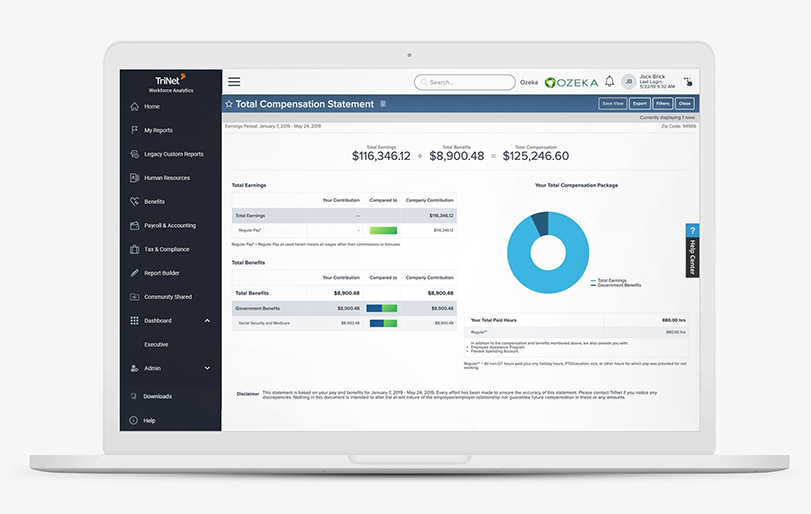
The TriNet platform handles payroll runs, benefits enrollment, time tracking, performance reviews, and basic reporting through a unified dashboard. Employee self-service through the mobile app is solid for accessing pay stubs, tax forms, benefits cards, and PTO balances. The platform is not as elegant as Justworks, and the reporting layer is less flexible than what HRIS-first tools like Rippling or Gusto offer, but it is functional and reliable for the core PEO workflows.
Where TriNet Falls Short
Pricing is opaque and increases yearly
The biggest practical complaint from TriNet clients is price opacity combined with steady annual increases. The initial quote requires a sales conversation, the contract structure is not always clearly explained, and renewal pricing typically rises 5 to 10 percent annually even when nothing about the client’s situation has changed. Some users have reported additional fees labeled as platform fees or innovation fees that were not clearly disclosed in the original contract. None of this is unique to TriNet (most PEOs work this way), but if you want flat, predictable, published pricing, Justworks is the more transparent option.
Reporting and customization are limited
The standard reporting library is adequate but not deep. Custom reports often require working with a TriNet support contact rather than self-serving through the platform. Companies with sophisticated HR analytics needs, complex departmental cost allocation requirements, or non-standard pay structures often hit the ceiling of what TriNet’s reporting can do without manual workarounds. Larger or data-heavy organizations frequently end up exporting to Excel or BI tools to do the analysis they actually want.
Integration ecosystem is thin
TriNet has integrations with major accounting platforms (QuickBooks, NetSuite), some 401(k) providers, and a handful of HRIS-adjacent tools, but the integration library is noticeably narrower than what Rippling, Gusto, or even Justworks offer. If your tech stack includes specialized recruiting platforms, performance management tools, or learning management systems, expect to do CSV imports rather than API syncs.
The mid-market exit problem
Many TriNet clients eventually outgrow the PEO model, typically somewhere between 50 and 100 employees. At that headcount, companies often build internal HR teams, want to negotiate their own benefits directly, and find the per-employee fees harder to justify. Leaving a PEO is not trivial: you have to set up your own payroll tax accounts in every state, transition benefits to a new broker, and rebuild compliance infrastructure. TriNet does provide offboarding support, but the process can take several months and is genuinely disruptive. Buyers who expect to scale rapidly past 100 employees in the next two years should factor this exit cost into the evaluation.
Not a fit for high-risk industries
Heavy construction, oil and gas extraction, and certain other high-risk industries are not eligible for TriNet’s PEO services because of workers’ compensation underwriting limits. If your business is in one of these sectors, you will need a specialty PEO or a direct workers’ comp carrier rather than TriNet.
How TriNet Compares
| Feature | TriNet | Justworks | Insperity |
|---|---|---|---|
| Pricing model | Custom quote, PEPM | Published flat PEPM | Custom quote, often percent of payroll |
| Typical admin cost (PEPM) | $100 to $150 | $59 to $109 (published) | Comparable to TriNet, varies by industry |
| Employee minimum | 5 | 2 | 5 |
| Industry specialization | Strong, vertical teams | Limited | Moderate |
| Hands-on HR advisory | Solid, by industry | Lighter, self-serve | Deepest in category |
| Platform UX | Functional | Best in class | Functional, less modern |
| Contract flexibility | Month-to-month, 30 days notice | Month-to-month | Often annual contract |
| Best fit headcount | 10 to 100 | 2 to 175 | 10 to 250 |
The short version: Justworks if you want simpler payroll and transparent pricing; Insperity if you want the deepest hands-on HR advisory; TriNet if industry-specific expertise matters more than either of those.
Who TriNet Is Best For
TriNet is the right fit if most of these apply:
- 10 to 100 employees with plans to stay roughly in that range or grow gradually
- You operate in one of TriNet’s core verticals: technology, life sciences, financial services, professional services, nonprofits, or hospitality
- You want access to large-group benefits without negotiating with carriers directly
- You want industry-aware HR advice rather than generic guidance
- You can absorb a custom-quoted, mid-to-premium price point in exchange for the bundled service
- You want a co-employer relationship that handles payroll tax liability and compliance infrastructure
TriNet is the wrong fit if any of these apply:
- You have fewer than 5 employees (consider Justworks instead)
- You are in heavy construction or another excluded high-risk industry
- You want flat published pricing with no sales conversation
- You expect to scale past 150 employees in the next 18 to 24 months and want to avoid PEO exit costs
- Your tech stack depends on deep API integrations with specialized HR tools
- You only need standalone payroll, in which case Gusto or the TriNet Payroll-only tier may be cheaper
Final Verdict
TriNet is a credible, accredited PEO that earns its place in the small-business HR conversation primarily through its industry-vertical model and its benefits buying power. It is not the cheapest PEO, it is not the most transparent, and it is not the most modern platform in the category, but for a 25-person biotech, a 60-person fintech, or a 40-person professional services firm, the vertical expertise often justifies the premium.
The honest summary: if you fit one of TriNet’s core industries and value HR support that understands your sector, it is a strong choice. If you want simplicity, transparent pricing, and a self-serve experience, Justworks is the better starting point. If you want the deepest hands-on advisory across HR, payroll, recruiting, and training, Insperity is the more involved partner. The PEO category rewards matching the tool to the use case, and TriNet’s use case is industry fit.
Get a quote, ask explicitly about year-two pricing and any platform or innovation fees, compare it against at least Justworks and one other competitor, and pressure-test the benefits package against what an independent broker could put together for your specific company. The right PEO is rarely obvious from the marketing pages.
FAQ
Is TriNet a PEO or an HRIS?
TriNet is primarily a PEO, meaning it acts as a co-employer and handles payroll tax filing, benefits, and compliance under its own employer identification number. TriNet also sells a standalone HRIS called the TriNet HR Platform (built on the former Zenefits product), which provides HR software without the co-employer relationship. The two products have different pricing and different service levels.
How much does TriNet actually cost?
TriNet does not publish pricing. Third-party benchmarks place the full PEO administrative fee at roughly $100 to $150 per employee per month, with the wider market range running from $80 to $300 depending on industry, headcount, and benefits selections. Benefits premiums (health, retirement, ancillary) bill separately on top of the admin fee. Pricing can change, so confirm current figures with TriNet directly.
What is the minimum number of employees to use TriNet?
The standard minimum is five employees, though TriNet has been reported to make exceptions for three or four employees in specific verticals. Businesses below this threshold typically have better luck with Justworks, which has a two-employee minimum.
How does TriNet compare to Justworks?
Justworks offers transparent published pricing, a more modern platform UX, and a lower employee minimum. TriNet offers industry-specific HR support, broader benefits selection, and stronger expertise for businesses in regulated sectors. Justworks tends to be the better fit for generalist small businesses; TriNet tends to be the better fit for businesses where vertical expertise matters.
How does TriNet compare to Insperity?
Insperity offers the deepest hands-on HR advisory in the category, including assigned specialists across HR, payroll, safety, and recruiting. TriNet offers vertical-specific expertise but with somewhat less hands-on touch on a per-client basis. Insperity is often a better fit for companies that want a near-fully-outsourced HR team; TriNet is often a better fit for companies that want industry-aware advisory without the full embedded model.
Is TriNet IRS certified?
Yes. TriNet is an IRS Certified PEO (CPEO) and is also accredited by the Employer Services Assurance Corporation (ESAC). CPEO status provides specific federal tax liability protections that non-certified PEOs cannot offer, including protection from successor liability for federal employment taxes.
Can I cancel TriNet at any time?
TriNet contracts are generally month-to-month, with at least 30 days’ written notice required for cancellation. Cancellation fees may apply in certain situations, such as mid-quarter exits or unfulfilled implementation commitments. Always read the specific contract terms before signing, as terms can vary by client and can change.
Does TriNet handle multi-state payroll?
Yes. As a national PEO, TriNet handles payroll tax registration and filing across all 50 states. This is one of the more practical reasons companies with remote employees turn to a PEO rather than building multi-state payroll infrastructure in-house. Note that state-by-state requirements can change, and a CPA should be consulted for jurisdiction-specific tax planning.
What industries does TriNet not support?
TriNet does not provide PEO services to heavy construction, oil and gas extraction, and certain other high-risk industries due to workers’ compensation underwriting limits. Businesses in these sectors generally need a specialty PEO or direct workers’ comp carrier instead.
Should I use the TriNet PEO or the TriNet HR Platform?
The PEO is the right choice if you want co-employment, large-group benefits, and full HR outsourcing. The HR Platform is the right choice if you already have benefits and payroll handled and just need HRIS software for onboarding, document management, and basic HR workflows. The PEO is significantly more expensive but bundles substantially more service. The two products serve different needs and should not be evaluated as direct substitutes.Last updated on May 9, 2026