ADVERTISING DISCLOSURE: THIS POST CONTAINS AFFILIATE LINKS. READ FULL DISCLAIMER
The Verdict: Remote handles international hiring and payroll in 90+ countries through its own legal entities, not partner networks. This means direct compliance accountability when you employ someone where you have no business presence. EOR starts at $599/month per employee, contractor management at $29/month. Strong ratings for compliance simplicity and transparent pricing. Best for companies hiring international employees where setting up your own entity doesn’t make sense.
Last updated May 1, 2026.
In This Review
What Remote Is
Remote is a global employment platform that lets you hire and pay employees and contractors in 90+ countries without setting up local legal entities. The company was founded in 2019 by Job van der Voort and Marcelo Lebre, both former GitLab executives who saw the compliance gaps in international hiring firsthand.
Remote owns its legal entities in the countries where it operates, rather than relying on third-party partner networks. This structural difference matters when you need to know who actually employs your worker and who carries compliance risk. When you hire through Remote’s Employer of Record (EOR) service, Remote is the legal employer on paper. You direct the work, they handle contracts, payroll, benefits, and statutory filings.
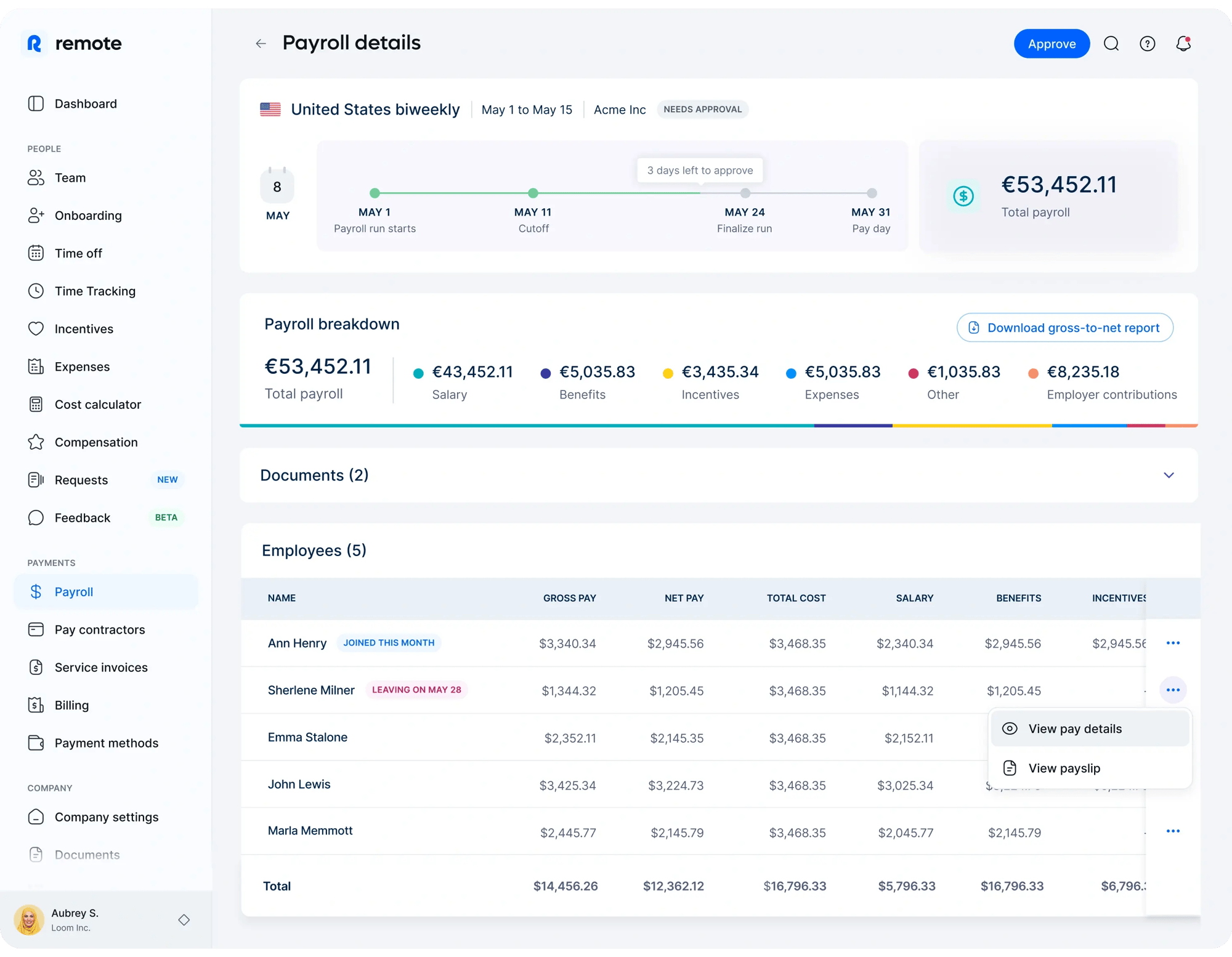
The platform offers four core products: EOR for full-time international employees, Contractor Management for independent contractors, Global Payroll for companies with their own entities, and Remote HRIS for core HR workflows. Most buyers come to Remote for EOR, which remains the anchor product.
What Remote Is Not
Remote is not a talent marketplace. There is no pre-vetted candidate pool, no skill assessments, and no job success scores. You find the talent, Remote employs them. The compliance problem is solved. The quality-of-hire problem is entirely on you.
Remote is also not a full-featured HRIS replacement. The platform handles core HR workflows like onboarding, time-off tracking, and document management, but it lacks the depth of dedicated HRIS platforms in areas like performance management, succession planning, and advanced workforce analytics.
Remote Pricing
Remote publishes its starting prices, which is rare in the EOR space. But the headline number is not the full cost. You pay Remote’s service fee plus all employer-side obligations in the worker’s country (payroll taxes, statutory benefits, mandatory insurance).
The platform fee is only one piece of total employment cost. A $5,000/month salary in the UK becomes roughly $5,850/month once you add employer National Insurance contributions (approximately 13.8%) and Remote’s $599 EOR fee. The total varies significantly by country based on local labor law.
| Product | Price | What’s Included |
|---|---|---|
| Employer of Record (EOR) | $599/employee/month (annual) or $699/month (month-to-month) | Legal employment, payroll, benefits, compliance, employment contracts, tax filings, HR Core included |
| Contractor Management | $29/contractor/month | Contracts, invoicing, payments in 100+ currencies, compliance documentation, Fair Price Guarantee (only pay for active contractors) |
| Contractor Management Plus | $99/contractor/month | Everything in standard tier plus misclassification penalty coverage up to $100,000/contractor, enhanced compliance protections |
| Contractor of Record | From $325/contractor/month | Remote engages and pays contractors directly through its entities, full compliance liability transfer |
| Global Payroll | $29/employee/month | Multi-country payroll for companies with own entities, implementation fee and payroll delivery fee apply separately |
| Remote HRIS | Free (included with EOR/payroll) or standalone pricing available | Employee records, document management, time-off tracking, org charts, workflows, compliance tools |
Hidden cost reality: At $599/month per employee, a 15-person international team generates $8,985/month in EOR fees before a single salary is paid. That is $107,820 annually just for the platform. This is not a Remote-specific issue (all per-employee EOR models work this way), but buyers often underestimate how fast the math compounds at scale. Several G2 reviewers flag this exact pain point once headcount crosses double digits.
What Affects Your Final Price
Country-specific costs vary wildly. Employer tax obligations in Germany are higher than in Portugal. Statutory benefits in France differ from those in Mexico. Remote converts cross-border payments using its own FX rate, which can add margin above mid-market rates.
The Global Payroll product carries an implementation fee (amount not published, requires quote) plus a recurring payroll delivery fee per payroll run. These fees sit on top of the $29/employee/month base rate.
Get a Custom Quote from Remote
Key Features
Remote’s feature set centers on compliance infrastructure and international employment workflows. The platform is not trying to be a full-suite HRIS. It is built to solve one problem well: employing people legally in countries where you have no entity.
Employer of Record (EOR)
Remote’s EOR service employs workers through its owned legal entities in 90+ countries. This is the structural differentiator the company markets most aggressively. Owned entities mean Remote controls compliance, rather than relying on third-party partners who may or may not execute correctly.
When you hire someone through Remote EOR, the platform generates a locally compliant employment contract, registers the worker with relevant tax authorities, enrolls them in mandatory benefits, processes payroll in local currency, and handles all statutory filings. You direct the work. Remote is the employer on paper.
The onboarding workflow walks through country-specific requirements step by step. Background checks, right-to-work verification, and tax documentation are built into the flow. Most onboardings complete in days, not weeks, assuming the worker provides documents promptly.
Contractor Management
Remote’s contractor product handles contracts, invoicing, and payments for independent contractors in 100+ countries. The Fair Price Guarantee means you only pay for contractors you are actively working with. If a contractor stops invoicing, you stop paying Remote.
The platform generates locally compliant independent contractor agreements, processes contractor invoices, handles multi-currency payments, and provides tax documentation (1099s in the US, equivalent forms elsewhere). Contractors submit invoices through the portal, Remote reviews for compliance flags, and payments go out on your approval.
Contractor Management Plus ($99/month) adds misclassification penalty coverage up to $100,000 per contractor and $1 million per client. This is genuine indemnity protection, not just advisory guidance. If a contractor is reclassified as an employee by local authorities and you followed Remote’s compliance recommendations, Remote covers the penalty.
Global Payroll
For companies that already have legal entities in multiple countries, Remote’s Global Payroll product consolidates payroll processing into one platform. You maintain your entities, Remote runs payroll across them.
The service handles multi-country payroll calculations, tax withholdings, statutory filings, and pay slip generation. Employees get paid in local currency on local schedules. Finance teams get consolidated reporting and journal entry exports for accounting systems.
Implementation requires entity setup per country, which carries a separate fee. Ongoing payroll delivery fees apply per payroll run. Total cost depends on how many entities you are running payroll through and how frequently payroll runs.
Remote HRIS
Remote HRIS (called HR Core in some documentation) is included free with EOR and Global Payroll services. It provides the basics: employee records, document storage, time-off tracking, org charts, and approval workflows.
This is not a full HRIS replacement. There is no performance management module, no succession planning, no advanced compensation modeling, and no deep workforce analytics. It handles core operational HR tasks so you are not managing international employees in spreadsheets.
The HRIS module integrates with Remote’s other products, so employee data flows between EOR, payroll, and HR records automatically. Single sign-on (SSO) and role-based access controls meet basic enterprise security requirements.
Compliance and IP Protection
Remote provides IP assignment agreements that ensure intellectual property created by your workers belongs to your company, not to Remote as the legal employer. This is table-stakes for any EOR, but worth confirming during procurement.
The platform monitors regulatory changes in the countries where you employ people and flags compliance updates that affect your workforce. Statutory minimum wage increases, mandatory benefit changes, and tax law updates surface in your dashboard with action items.
Benefits Administration
Remote handles mandatory benefits (health insurance, pension contributions, statutory leave) as part of the base EOR service. Optional benefits (supplemental insurance, wellness programs) are available in some countries but require add-on fees.
Benefits customization varies by country. In markets with strong statutory frameworks (most of Europe), there is limited room to differentiate. In markets with flexible benefit structures (like the US through Remote’s PEO product), you have more control over plan design.
Where Remote Stands Out
Owned Entities, Not Partner Networks
Remote owns its legal entities in the countries where it operates EOR services. This is not universal in the EOR industry. Many providers use third-party partner networks, which introduces coordination risk and compliance gaps.
When Remote is the employer, Remote controls execution. There is no game of telephone between you, the EOR platform, and a local partner who actually employs the worker. The compliance liability sits with Remote, and they own the infrastructure to manage it.
Transparent Pricing (With Caveats)
Remote publishes starting prices on its website, which most EOR competitors do not. The $599/month EOR fee and $29/month contractor fee are real numbers you can use for budget modeling before talking to sales.
The caveat: these are platform fees only. Total employment cost includes employer taxes and statutory benefits, which Remote does not and cannot publish because they vary by country and salary level. But knowing the platform fee upfront is still more transparency than most of the market offers.
Contractor-to-Employee Conversion
Remote makes it operationally simple to convert a contractor into a full-time employee. The worker’s profile, documents, and history carry forward from Contractor Management into EOR. No data re-entry, no duplicate onboarding flows.
This matters when you hire someone as a contractor to test fit, then want to bring them on full-time once the relationship proves out. The conversion takes minutes in the platform, not weeks of paperwork.
Compliance for Remote-First Companies
Remote was built by people who ran distributed teams at GitLab. The product reflects that origin. The platform assumes your default state is distributed, not that you are a traditional company dabbling in remote work.
Workflows are optimized for async communication, documentation is built for teams across time zones, and compliance tooling assumes you are hiring in countries you have never operated in before. This is genuinely differentiated from HRIS platforms that bolted on international features later.
Where Remote Falls Short
Support Responsiveness for Urgent Issues
Support responsiveness is the most consistent complaint in both G2 and Trustpilot reviews. When you have a payroll error or compliance question that needs resolution in hours, not days, ticket-based support with 24 to 48-hour response times creates real operational friction.
The pattern is clear across reviews: routine questions get answered promptly, complex or country-specific issues take longer, and urgent escalations feel slower than the urgency warrants. This is not unique to Remote, but it is a documented pain point worth validating during your trial period.
Several reviewers note that chatbot-first support creates unnecessary friction when you need a human immediately. The AI chat works fine for policy lookups. It does not work when payroll did not run and employees are asking where their money is.
Per-Employee Pricing Compounds at Scale
At $599/month per employee, the math works cleanly for small teams. A five-person international team pays $2,995/month in platform fees. That is manageable.
At 15 employees, you are paying $8,985/month ($107,820/year) just for the platform before any salaries or employer taxes. At 30 employees, that jumps to $17,970/month ($215,640/year). The per-employee model creates a structural incentive to under-hire, which works against the platform’s core use case.
G2 reviewers managing growing headcounts flag this exact issue. The pricing model that made sense at five employees starts to strain at 20. By the time you hit 50 international employees, you are spending over $350,000 annually on EOR platform fees alone.
Limited HRIS Depth
Remote HRIS handles core operational tasks, but it is not a full-featured HRIS. There is no performance management, no goal tracking, no succession planning, and no advanced compensation modeling.
If you need those capabilities, you will run a separate HRIS alongside Remote. The platform integrates with tools like BambooHR and Workday, but you are managing two systems and paying for both.
No Talent Vetting or Recruitment Layer
Remote does not vet candidates, assess skills, or maintain a talent pool. Remote Talent (the company’s job board) exists, but it is not a pre-screened marketplace. You post jobs, candidates apply, you screen them, you make offers. Remote handles employment after you decide to hire.
This is a structural product decision, not a gap. Remote is compliance infrastructure, not a recruiting platform. But buyers coming from talent marketplaces often expect candidate vetting to be part of the package. It is not.
FX Conversion Margins
Remote converts cross-border payments using its own FX rate. These rates include a margin above mid-market rates to cover banking costs and FX risk. The exact margin is not published.
Trustpilot reviews mention FX deductions as a pain point, particularly for contractors and employees paid in currencies other than their local currency. This is standard practice across global employment platforms, but it is worth factoring into total cost.
What Real Users Say
Remote holds a 4.7/5 rating on G2 (6,500+ reviews) and a 4.6/5 on Trustpilot. Capterra scores it at 4.4/5. These are strong numbers, but the gap between G2 (HR buyers) and Trustpilot (employees and contractors) is worth noting.
G2 reviews skew toward HR teams and procurement buyers evaluating Remote as an operational tool. Trustpilot captures employees and contractors who experience payment delays, support lag, or country-specific onboarding friction. The score gap reflects audience, not just satisfaction.
Common Praise
What users consistently highlight: Compliance simplicity is the top theme. HR teams cite the ability to onboard someone in a new country in days rather than months as the platform’s primary value. Reviewers running distributed teams describe payroll consistency as genuine operational relief: no entities to maintain, no local accountants to manage, single dashboard for all headcount. Pricing predictability surfaces frequently. Unlike platforms that charge percentage-of-salary or layer on variable markups, Remote’s flat monthly fee makes budget forecasting straightforward once you know headcount. The contractor-to-employee conversion workflow gets specific praise for eliminating duplicate data entry.
Common Complaints
What users consistently flag: Support responsiveness for time-sensitive issues is the most frequent complaint across both G2 and Trustpilot. When a payroll error or compliance question needs resolution quickly, waiting 24 to 48 hours for a reply creates operational problems. Fee compounding at scale is the second recurring issue. At $599/month per employee, a 15-person team generates over $9,000/month in EOR fees before any salaries. Reviewers managing growing headcounts note the math works at small scale but strains as teams expand. FX conversion margins and withdrawal fees surface in contractor reviews on Trustpilot.
Who Should Use Remote
Remote is the right fit when:
- You need to hire full-time employees in countries where you have no legal entity and setting one up is not justified by headcount.
- Compliance liability transfer matters more than cost optimization. You want the EOR to own the employment risk, not just advise on it.
- You are hiring in multiple countries simultaneously and need one platform to manage all of them without coordinating separate local partners.
- Your team is distributed by default, not remote as an exception. The product assumes async workflows and international operations from the ground up.
- You need to convert contractors into employees as relationships prove out, and you want that conversion to be operationally simple.
- Transparent starting prices matter for budget planning, even if total cost includes country-specific variables you cannot control.
Who Should Not Use Remote
Remote is not the right fit when:
- You are hiring 30+ international employees and per-employee platform fees become a material line item in your P&L. The math compounds fast at scale.
- You need candidate vetting, skill assessments, or a pre-screened talent pool. Remote is employment infrastructure after you find the talent, not a recruiting marketplace.
- You require deep HRIS functionality like performance management, succession planning, or advanced workforce analytics. Remote HRIS handles core operational tasks only.
- You need white-glove support with guaranteed response times for urgent issues. Support is responsive for routine questions but slower for complex escalations.
- You already have entities in most target countries and just need payroll processing. Global Payroll works, but dedicated payroll providers may offer better per-run economics.
- Your primary workforce is contractors, not employees. Contractor Management works well, but platforms built contractor-first (like Deel) may better match your workflows.
Remote vs. Alternatives
Remote competes directly with Deel, Rippling, Oyster, and Papaya Global in the global employment platform space. Each takes a different approach to the same core problem.
| Platform | Best For | Starting Price | Key Difference |
|---|---|---|---|
| Remote | Compliance-first EOR with owned entities | $599/employee/month (EOR) | Owns legal entities in 90+ countries, no partner networks |
| Deel | Contractor-heavy teams, fast payouts | $49/contractor/month, EOR pricing varies | Started contractor-first, strongest in cross-border payouts and multiple withdrawal methods |
| Rippling | Full HRIS + IT management + EOR | Platform fee plus modules (quote-based) | Only platform that unifies HR, IT device management, and software provisioning in one system |
| Oyster | Small teams, simple EOR needs | $499/employee/month (EOR) | Lower price point than Remote, smaller country coverage (180+ vs 90+), lighter feature set |
| Papaya Global | Enterprise payroll aggregation | Custom enterprise pricing | Built for large enterprises consolidating payroll across existing entities, not startups adding first international hires |
Quick Pick Guide
- Choose Remote if compliance liability transfer is non-negotiable and you value owned entities over partner networks. Best fit for distributed-first companies hiring employees internationally.
- Choose Deel if your workforce is contractor-heavy or you need flexible payout methods across many currencies. Deel’s contractor product is more mature than Remote’s.
- Choose Rippling if you need a full HRIS plus IT device management alongside EOR. Only makes sense if you want one platform for HR, IT, and global employment together.
- Choose Oyster if you are hiring your first few international employees and want a lower price point with simpler features. Trade country coverage and depth for lower cost.
- Choose Papaya Global if you are an enterprise with existing entities in many countries and need payroll aggregation with deep financial reporting. Not built for startups.
Popular Integrations
Remote integrates with major HRIS, payroll, accounting, and recruiting platforms through both native connectors and API access. The integration strategy focuses on bi-directional data sync to eliminate duplicate entry.
HRIS and Payroll
- BambooHR (employee data sync)
- Workday (enterprise HRIS integration)
- Hibob (employee sync for shared data)
- Rippling (integration available despite competitive positioning)
Accounting and Finance
- QuickBooks Online (payroll journal entries, expense sync)
- Xero (payroll export, general ledger sync)
- NetSuite (ERP integration for enterprise finance teams)
- Sage (accounting platform integration)
Recruiting and ATS
- Greenhouse (candidate-to-hire data push at offer stage)
- Lever (recruiting workflow integration)
- Ashby (ATS integration for candidate handoff)
Collaboration and Communication
- Slack (workflow notifications, time-off approvals, automated alerts for payroll and compliance events, requires Remote HRIS)
- Microsoft Teams (notifications and workflow triggers)
Single Sign-On and Security
- Okta (SSO and identity management)
- OneLogin (single sign-on provider)
- Google Workspace (SSO integration)
- Microsoft Entra ID (formerly Azure AD)
Remote also provides REST API access for custom integrations. The API supports employee data retrieval, payroll reporting, and document management workflows. API documentation is available to customers through the Remote support portal.
Frequently Asked Questions
Does Remote offer a free trial?
No. Remote does not offer a free trial. The platform requires signed agreements and legal entity setup per country before onboarding workers, which does not fit a trial model. Most buyers go through a demo and pricing quote process before committing.
How much does Remote cost for a 10-person company?
If all 10 people are full-time employees hired through EOR on annual contracts, the platform fee is $5,990/month ($71,880/year). This is the Remote service fee only. Total employment cost includes gross salaries plus employer-side taxes and benefits in each employee’s country. A UK employee at $60,000 annual salary costs roughly $69,000 total once you add employer National Insurance and the Remote fee.
Is Remote worth it, or should I use Deel instead?
Remote is worth it if compliance liability transfer and owned entities matter more than cost flexibility. Deel is worth it if your workforce is contractor-heavy or you need more payout method options. Both are credible platforms. The decision depends on whether you are hiring employees or contractors, how much you value owned entities versus partner networks, and whether transparent upfront pricing or modular product flexibility matters more to you.
Can Remote handle US-based employees, or is it only for international hires?
Remote offers a PEO product for US-based employees in all 50 states. This works like EOR but uses the Professional Employer Organization model common in the US. Pricing is separate from international EOR. If your entire team is US-based, dedicated US payroll and PEO providers may offer better economics.
How long does Remote take to onboard a new employee?
Most onboardings complete in 3 to 7 business days, assuming the employee provides required documents promptly. Complex cases (first hire in a new country, unusual visa situations, industry-specific licensing) can take longer. Background checks add time depending on the country and check depth required.
Is Remote’s contractor management good enough to replace a dedicated contractor platform?
For basic contractor workflows (contracts, invoicing, payments), yes. Remote Contractor Management handles the fundamentals well. If you need advanced features like milestone-based payments, escrow services, or detailed contractor performance tracking, dedicated platforms like Deel or Upwork may fit better. The advantage of Remote is seamless contractor-to-employee conversion if relationships evolve.
Does Remote integrate with QuickBooks?
Yes. Remote integrates with QuickBooks Online to sync payroll journal entries and expense data. The integration automates financial record-keeping so payroll costs flow into your accounting system without manual entry. QuickBooks Desktop integration is not natively supported but can be handled through third-party tools like Zapier.
Is Remote SOC 2 compliant?
Yes. Remote holds SOC 2 Type 2 certification and ISO 27001 certification. The company publishes a Trust Center with full compliance documentation. For enterprise buyers, Remote supports SSO, SCIM provisioning, and role-based access controls to meet IT security requirements.
Does Remote offer discounts for startups or nonprofits?
Remote offers startup-specific pricing for eligible companies: 50% off the first employee for one year, or 12 months for the price of 10 on additional employees during the first year. Nonprofit pricing is available but requires direct contact with sales for quote. These discounts apply to the platform fee only, not to employer taxes or statutory benefits.
What is Remote’s cancellation policy?
For annual EOR contracts, you commit to 12 months per employee. Month-to-month contracts allow cancellation with notice (typically 30 days, varies by country). Employee offboarding follows local labor law, which means notice periods and severance obligations depend on the country. Remote handles compliant offboarding, but you pay any statutory severance required by local law.
Can Remote replace a dedicated global payroll service?
Only if you have your own entities in the target countries. Remote’s Global Payroll product runs payroll through entities you already own. If you do not have entities and need to hire internationally, you need EOR, not global payroll. For companies with existing entities, Remote Global Payroll consolidates multi-country payroll into one platform, but dedicated global payroll providers like CloudPay or Papaya Global may offer more enterprise-grade features.
Is Remote right for agencies hiring project-based contractors short-term?
It depends. If you hire contractors for 6+ month engagements and need clean compliance documentation, Remote Contractor Management works well. For very short-term gigs (a few weeks) or project-based marketplaces, platforms like Upwork or Toptal may fit better because they are built around short-duration, project-specific work. Remote’s strength is ongoing contractor relationships, not ad-hoc project staffing.
Final Verdict
Remote solves one problem well: employing people internationally without setting up your own legal entities. The platform owns entities in 90+ countries, handles payroll and benefits administration, and takes on compliance risk. You find the talent, Remote employs them legally.
The strengths are clear. Owned entities mean direct compliance accountability with no third-party partners in the middle. Transparent pricing lets you budget before talking to sales. Onboarding happens in days, not months. Strong user ratings (4.7/5 on G2) reflect genuine operational value for distributed teams.
Limitations matter depending on your needs. The HRIS is basic (no performance management or deep analytics). Support can be slow for complex issues. Per-employee costs compound as teams grow past 20 to 30 people. And you still need to find candidates yourself—Remote is employment infrastructure, not a talent marketplace.
Remote fits when you are hiring international employees, compliance matters more than cost minimization, and you value structural simplicity. It works for companies where international hiring is a growth strategy, not a one-off experiment.
Related Reads
- Deel Review: EOR Pricing, Features & Who Should Use It
- Rippling Review: HR, IT & Payroll Platform Breakdown
- BambooHR Review: HRIS Features, Pricing & Alternatives
Last updated on May 2, 2026