ADVERTISING DISCLOSURE: THIS POST CONTAINS AFFILIATE LINKS. READ FULL DISCLAIMER
The Verdict: Buildium is the default property management platform for residential portfolios in the 50 to 1,500 door range, and it earns that position. Accounting holds up under audit, the resident and owner portals are mature, and onboarding is fast. Pricing starts at $62 per month and tops out at $400, but transaction fees push real cost 30 to 50 percent above the headline number. Best for established property management companies; overkill for individual landlords with under 10 units.
Last updated May 8, 2026.
In This Review
What Buildium Is
Buildium is a cloud-based property management platform built for residential property managers, community association managers, and small-to-mid-sized portfolios. It was acquired by RealPage in 2019 and now sits inside the broader RealPage ecosystem, but it continues to be developed as a standalone product.
The platform consolidates the operating loop of a property manager into one interface: rent collection, tenant screening, lease management, maintenance ticketing, vendor billing, owner reporting, and accounting. It is built for the operator running 50 to 1,500 doors, not the individual landlord with three units and not the enterprise managing 5,000.
Buildium handles single-family rentals, small multifamily buildings, mixed portfolios, and community associations (HOAs and condos). It does not lean toward commercial property or student housing. Operators with more than about 1,500 units typically migrate to AppFolio, Yardi, or Rent Manager for deeper customization.
What Sets Buildium Apart in the Property Manager Market
Two things separate Buildium from lighter competitors. First, the resident and owner portals are genuinely mature: tenants pay rent, submit maintenance requests, and access documents through their portal, while owners pull real-time financial reports through theirs. For a property manager handling owners who expect to log in and see numbers without calling, that owner portal alone often justifies the platform choice.
Second, the accounting is purpose-built for property management, not a generic ledger bolted onto leasing tools. Trust accounting, owner draws, security deposit tracking, and 1099 e-filing are native, which matters more than it sounds when you have an audit or a state regulator asking questions.
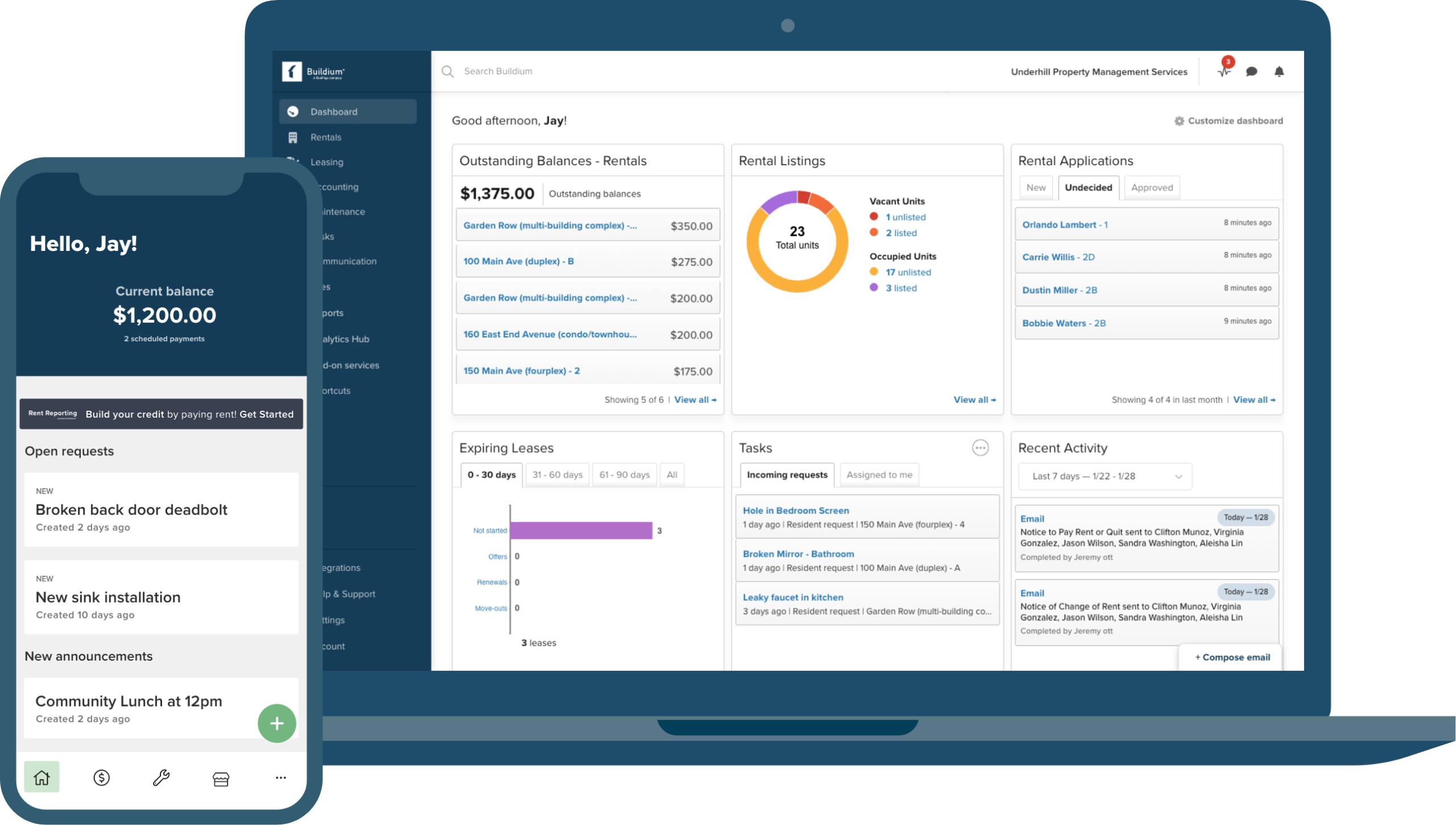
Source: buildium.com
Buildium Pricing
Buildium uses a flat monthly tier structure with three plans, and pricing scales with door count within each tier. There is a 14-day free trial with sample data and no credit card required, and annual billing is discounted.
| Plan | Price | What’s Included |
|---|---|---|
| Essential | From $62/month (capped at 150 units) | Accounting, maintenance, tasks, online portals, resident and board communications, ticket support. eSignatures and inspections charged per use. |
| Growth | From $192/month | Everything in Essential plus unlimited eSignatures, free property inspections, performance analytics, reduced EFT fees, live phone support. |
| Premium | From $400/month | Everything in Growth plus Open API access, priority support, dedicated growth consultant for client lead generation, Lumina AI suite. |
Important: The headline prices understate real cost. Incoming EFT runs $2.35 per transaction on Essential and $1.35 on Growth. Bank account setup is $99 per account on Essential. Credit card fees are 2.99 percent across all tiers. Several review sources put actual monthly spend roughly 30 to 50 percent above the published rate for a typical operating portfolio.
Which Plan to Pick
Essential is the right plan if you are managing under 150 units, not yet processing high eSignature volume, and not paying for API access. Growth is the sweet spot for established property management companies in the 100 to 500 unit range, and the reduced EFT fees alone usually offset the price step at meaningful door counts. Premium is only worth the jump if you specifically need Open API access for integrations or you want the dedicated growth consultant for new client acquisition.
Start Buildium’s 14-Day Free Trial
Key Features
Property Accounting
Accounting is the feature property managers actually evaluate Buildium on, and it is one of the platform’s strongest areas. Buildium runs a full double-entry general ledger purpose-built for property management, which means trust accounting, owner draws, security deposit tracking, and bank reconciliation behave the way an auditor expects.
You can run financial reports at the property level, owner level, or portfolio level, generate 1099s electronically at year end, and handle vendor payments and owner distributions without exporting to QuickBooks. The reporting library is broad rather than deep: standard reports cover the operational questions you ask weekly, but custom report building is more limited than what AppFolio or Rent Manager offer.
Online Rent Collection
Tenants pay rent through the resident portal via EFT, credit card, or cash at participating retail locations. Auto-pay is supported, late fees automate, and the system reconciles incoming payments against tenant ledgers without manual intervention. Chasing rent is the single biggest time sink for a small property management operation, and getting tenants onto auto-pay typically pays for the software within the first quarter.
Maintenance Management
Tenants submit maintenance requests through the portal with photos and descriptions. The property manager assigns the work order to a vendor, the vendor receives the assignment by email, work gets completed, and the bill flows back into the accounting system. The full request-to-payment loop is closed inside Buildium.
The mobile app side of maintenance is where users push back. Several reviewers describe the mobile experience as serviceable rather than impressive, and operators who manage maintenance heavily in the field sometimes layer a third-party tool like HappyCo on top.
Tenant Screening and Leasing
Buildium offers tenant screening with credit, criminal, and eviction history pulled through TransUnion. Screening costs are pass-through to the applicant in most setups, so the property manager does not absorb the fee. eSignatures for leases and addenda are unlimited on Growth and Premium, but charged per document on Essential, which is a meaningful upgrade trigger as your leasing volume grows.
Resident and Owner Portals
This is where Buildium pulls ahead of lighter competitors. Tenants get a fully featured portal for payments, maintenance, document access, and renters insurance. Owners get a portal with real-time financial reporting, distribution history, and property performance. The owner portal alone is often the reason Buildium gets selected over a stack of cheaper tools.
API and Integrations
Buildium offers an open API on the Premium plan, and the marketplace includes integrations with HappyCo for inspections, Tenant Turner for showing scheduling, LeadSimple for prospect management, and a growing list of others. For property managers who want to connect Buildium to a CRM or a custom reporting layer, the API is functional but does sit behind the highest pricing tier.
Where Buildium Stands Out
Predictable Tier Pricing
Most property management platforms charge per unit, which means costs compound as your portfolio grows. Buildium charges flat monthly tiers with door-count thresholds inside each tier, so you can forecast software cost a year out without surprises. This is one of the genuine reasons established property managers stay on Buildium even when alternatives look cheaper on the surface.
Onboarding Speed
Most teams report being fully live within days, not weeks. The interface is approachable enough that staff without prior property management software experience can navigate it after a brief training, and the Buildium Academy provides on-demand tutorials. Compare this to AppFolio or Rent Manager, where onboarding can run four to six weeks for a small company.
Owner Reporting
The owner portal and owner-facing reports are mature enough that property managers can use them as a sales tool when pitching new clients. Owners who want professional reporting without picking up the phone get exactly that, which reduces administrative load on the property manager and improves owner retention.
Where Buildium Falls Short
Hidden Transaction Fees
The published subscription price is not what you actually pay. Incoming EFT at $2.35 per transaction on Essential, plus $99 bank account setup fees, plus 2.99 percent credit card processing stack quickly. For a 100-unit operation collecting most rent via EFT on the Essential plan, the real monthly spend lands closer to $300 than $62.
Reporting Customization
If your reporting needs go beyond rent rolls, profit and loss by property, and standard owner statements, you may find yourself exporting to a spreadsheet to finish the job. AppFolio and Rent Manager offer materially more flexible custom reporting, which is one of the main reasons portfolios above 1,500 doors migrate off Buildium.
Bank Account Setup Delays
The underwriting process for new bank accounts can take 7 to 10 business days, with three months of bank statements often required for verification. For property managers onboarding a new property quickly, this delay is a genuine operational pain point that several Capterra reviewers have flagged.
Inconsistent Customer Support Quality
User feedback on Buildium support is genuinely split. Many reviewers describe the support team as responsive and knowledgeable, particularly on the Growth and Premium plans where live phone support is included. Others report slow ticket resolution, untrained first-line agents, and ignored follow-ups. Quality appears to vary by plan tier and by which support agent you reach.
What Real Users Say
Buildium holds a 4.5/5 rating on Capterra (roughly 2,000 reviews) and 4.4/5 on G2 (roughly 220 reviews). User sentiment skews positive overall, but the patterns in praise and criticism are consistent enough to summarize cleanly.
Common praise: Ease of use for staff without prior PM software experience, strong rent collection automation, owner portal as a sales advantage, and customer support quality on Growth and Premium plans. Multiple reviewers who have used Yardi, AppFolio, and DoorLoop name Buildium as the most approachable to learn.
Common complaints: Hidden transaction fees that surprise new customers, limited report customization, occasional platform glitches and slow page loads, security deposit and prepaid rent handling that several reviewers describe as clunky, and bank account setup delays that hold up new property onboarding.
Who Should Use Buildium
- Property management companies running 50 to 1,500 residential doors who want a single platform for accounting, leasing, and resident management
- Operators of mixed portfolios (single-family rentals plus small multifamily) who do not want to run separate platforms for each property type
- Community association managers who need HOA-specific functionality alongside rental management
- Property managers who pitch new owner clients and want professional owner reporting as a sales differentiator
- Small to mid-sized PM teams who need fast onboarding and cannot afford a four to six week implementation project
Who Should Not Use Buildium
- Individual landlords with under 10 units who do not need owner reporting or trust accounting (use RentRedi or TurboTenant)
- Portfolios over 1,500 doors needing deep custom reporting or commercial-specific features (use AppFolio or Yardi)
- Commercial-only or student housing operators whose needs Buildium does not specifically address
- Property managers with limited tolerance for transaction fees who want flat all-in pricing
- Operators who need API access on a budget, since Open API is gated to the $400/month Premium plan
Buildium vs. Alternatives
| Platform | Best For | Starting Price | Key Difference |
|---|---|---|---|
| Buildium | Established PM companies, 50 to 1,500 doors | $62/month | Strong accounting, mature owner portal, predictable tier pricing |
| DoorLoop | Small to mid PM companies wanting modern UX | $69/month | Cleaner interface, faster onboarding, similar price point |
| RentRedi | Individual landlords, under 25 units | $12/month | Simpler, cheaper, no owner reporting or trust accounting |
| AppFolio | Larger portfolios, 1,500+ doors | $298/month | Deeper reporting, stronger commercial support, per-unit pricing |
Quick Pick Guide
- If you are a property management company with 50 to 500 doors: Buildium
- If you want the cleanest modern UX at a similar price: DoorLoop
- If you are an individual landlord with under 25 units: RentRedi
- If your portfolio is past 1,500 doors or includes commercial: AppFolio
- If you need HOA management alongside rentals: Buildium
Popular Integrations
Buildium’s integration marketplace covers the major operational categories a property manager needs. Open API access is gated to the Premium plan, but most marketplace integrations work across all tiers.
Inspections and maintenance: HappyCo, Property Meld, Lula
Leasing and prospect management: Tenant Turner, ShowMojo, LeadSimple
Tenant screening: TransUnion (native), SmartMove
Insurance and protection: MSI Renters Insurance, Second Nature
Marketing and listings syndication: Zillow, Apartments.com, Realtor.com
Accounting and tax: Native 1099 e-filing, exportable to QuickBooks for firms that want a separate corporate ledger
Frequently Asked Questions
Does Buildium offer a free trial?
Yes. Buildium offers a 14-day free trial with sample data and no credit card required. You can convert to any of the three plans (Essential, Growth, or Premium) from the same trial without losing your work.
How much does Buildium cost for a 100-unit property management company?
Headline pricing for a 100-unit portfolio sits around $62 to $192 per month depending on tier, but real cost runs higher once transaction fees are included. A 100-unit company collecting most rent via EFT on Essential typically spends $250 to $300 per month all-in. Growth at $192 plus reduced EFT fees often costs roughly the same total.
Is Buildium worth it, or should I use DoorLoop?
Both serve the same market segment. Buildium has the edge on accounting depth, owner reporting maturity, and HOA functionality. DoorLoop has the edge on interface modernity and onboarding speed. If accounting and audit-grade trust accounts are non-negotiable, lean Buildium. If you are starting from scratch and want the cleanest UX, lean DoorLoop.
Can Buildium handle HOA and community association management?
Yes. Buildium is one of the few platforms that handles rental property management and HOA management in the same system, including reserve fund tracking, board member portals, violations, and association-specific accounting. This is a meaningful differentiator against DoorLoop and most rental-focused alternatives.
How long does Buildium take to implement?
Most teams are fully live within a week. Bank account setup adds 7 to 10 business days for underwriting verification, which can extend the timeline if you are setting up multiple bank accounts at once. Buildium Academy provides on-demand training, and Growth and Premium plans include onboarding consultations.
Does Buildium integrate with QuickBooks?
Buildium does not have a direct native QuickBooks sync, which is a known limitation for firms that want their property accounting flowing into a corporate general ledger. The platform does export financial data in QuickBooks-compatible formats, and the Open API on the Premium plan can be used to build a custom sync.
Is Buildium SOC 2 compliant?
Yes. Buildium is SOC 2 compliant, with encryption in transit and at rest, regular backups, and the security infrastructure expected of a RealPage-owned property management platform handling tenant payment data. This matters for property managers signing institutional or fund-owned portfolios that require vendor security attestation.
Does Buildium offer discounts for annual billing?
Yes. Annual billing is discounted versus monthly across all three plans, and the Essential plan setup fee is waived on Growth and Premium. There is no specific nonprofit, startup, or education discount program documented publicly.
What is Buildium’s cancellation policy?
There is no long-term contract on monthly billing. You can cancel from the Account and Billing page in your account at any time. Annual subscriptions are paid up front, and partial-year refunds are not standard practice based on user reports. Cancel before the annual renewal date to avoid auto-renewal charges.
Is Buildium right for an individual landlord with five units?
Probably not. Buildium is built for the property manager managing on behalf of owners, not for the individual landlord managing their own units. Five-unit landlords usually find Buildium’s pricing and feature scope mismatched to their needs. RentRedi or TurboTenant fit that profile better at a fraction of the cost.
Final Verdict
Buildium is the default recommendation for residential property management companies in the 50 to 1,500 door range, and it earns that position fairly. Accounting holds up, the portals work, the price point is reasonable for the value delivered, and onboarding is fast enough to be running real operations within a week.
The fee structure deserves attention before signing. Operators who lean heavily on custom reporting or field-based maintenance should test those workflows during the free trial, and individual landlords with under 10 units should look at lighter alternatives. For most property managers reading this, the right move is the 14-day trial on the plan that matches your current door count, with a plan to upgrade once eSignature volume or reporting depth becomes the bottleneck.
Buildium is unlikely to be the cheapest option in your stack, but it is one of the few that scales with you from 50 doors to 1,000 without forcing a platform migration along the way.
Last updated on May 8, 2026