ADVERTISING DISCLOSURE: THIS POST CONTAINS AFFILIATE LINKS. READ FULL DISCLAIMER
The Verdict: ADP Workforce Now is one of the most established mid-market HCM platforms in the industry, with genuinely strong payroll processing, compliance depth, and a learning management library that few competitors match. The honest friction points are real: opaque pricing, a steep learning curve, inconsistent customer support, and an interface that feels dated compared to newer competitors. It is best suited to organizations of 75 to 750 employees that value ADP’s payroll track record and compliance expertise over a modern user experience.
Last updated May 3, 2026.
In This Review
What ADP Is
ADP (Automatic Data Processing) is one of the largest and oldest HR and payroll companies in the world, founded in 1949 and now serving over one million businesses globally. ADP is not a single product, and that is the first thing to understand before evaluating it. The company offers multiple platforms for different business sizes and needs, which can make research confusing.
This review focuses on ADP Workforce Now, ADP’s flagship cloud-based HCM (human capital management) platform built for mid-market organizations. It is the product most HR and payroll professionals mean when they say “we use ADP” in a company of any meaningful size.
ADP’s Product Family at a Glance
Before going deeper on Workforce Now, here is where each ADP product fits so you can confirm you are evaluating the right one:
- RUN Powered by ADP: Built for small businesses with 1 to 49 employees. Focuses on payroll processing and basic HR. Starting price around $79/month plus per-employee fees. If you have fewer than 50 employees, RUN is likely the more appropriate starting point.
- ADP Workforce Now: Mid-market HCM platform for 50 to 1,000 employees. Covers payroll, benefits, time and attendance, talent management, and learning. This is the subject of this review.
- ADP Vantage HCM: Enterprise-grade platform for large organizations. Custom pricing, significantly higher cost.
- ADP TotalSource: A PEO (Professional Employer Organization) co-employment service, not a software platform in the traditional sense.
Small business owners: If you have fewer than 50 employees and are evaluating ADP for straightforward payroll, RUN Powered by ADP is the right product to evaluate, not Workforce Now. Workforce Now’s feature depth and pricing structure are sized for larger teams.
ADP Workforce Now Pricing
ADP Workforce Now does not publish pricing publicly. All pricing is custom, based on a per-employee-per-month (PEPM) model, and requires a demo and quote from the sales team. The modular structure means the price you pay depends on which features you select.
| What We Know | Details |
|---|---|
| Pricing model | Per employee per month (PEPM), custom quote required |
| Estimated software range | Approximately $19 to $30 per employee per month for software only, depending on modules selected (third-party estimates; confirm directly with ADP) |
| With Comprehensive Services | $30 to $50 PEPM when outsourced payroll and benefits management services are included |
| Implementation fee | Typically 10 to 20% of annual software cost; negotiable |
| Plan tiers | Select (core payroll and HR), Plus (adds benefits administration), Premium (adds time and attendance). Additional modules priced separately. |
| Free trial | Not available; demo and custom quote required |
Watch for add-on costs. Multiple user reviews flag that time tracking, advanced analytics, learning management, and benefits reporting each come at additional cost beyond the base plan. The number on your initial quote will likely be lower than what you actually pay once you add the modules you need. Get a fully itemized quote that includes every module your team requires before signing anything.
For a team of 100 employees at a mid-range estimate of $25 PEPM, the annual software cost would be approximately $30,000 per year, plus an implementation fee. At the high end of the range with add-ons, that number can climb significantly. This is mid-market pricing for a mid-market product, but it is real money that warrants scrutiny.
Key Features
Payroll Processing and Tax Compliance
Payroll is ADP’s oldest and strongest capability. Workforce Now handles payroll processing, automated tax calculations, multi-state compliance, direct deposit, wage garnishments, and year-end W-2 and 1099 generation across all US states. ADP’s tax compliance infrastructure is among the most battle-tested in the industry, updated automatically as federal, state, and local tax tables change.
The platform also includes AI-powered anomaly detection that flags payroll errors before a run is finalized, which reduces costly corrections after the fact. For payroll managers who have been burned by errors in less mature systems, ADP’s depth here is a genuine differentiator.
One cost to flag: ADP charges a per-employee fee for W-2 filing at year end, which is not included in the base PEPM rate. Confirm this line item during your pricing conversation so it does not surface as a December surprise.
Benefits Administration
The Benefits module covers medical, dental, vision, FSA, HSA, COBRA, and ACA compliance. Open enrollment is managed within the platform, with employees making elections through a self-service portal. Benefits data syncs directly to payroll so deductions update automatically when elections change.
ADP’s benefits administration is available on the Plus and Premium plans. The Select plan, which covers only core payroll and basic HR, does not include it. If benefits administration is a core requirement, confirm it is included in your quote from the start.
Time and Attendance
The Premium plan adds a full time and attendance module covering employee scheduling, time tracking, time-off management, and accruals. Time collection options include mobile clock-in, web entry, kiosk terminals, and physical time clocks. Geofencing for location-based clock-in enforcement is available for organizations with field staff or multiple physical sites.
Approved time flows directly into payroll, eliminating the manual import step. For organizations where time tracking is complex (multiple pay rates, shift differentials, union rules), this integration is one of ADP’s stronger selling points.
HR Management and Compliance
Workforce Now includes a centralized employee database, structured onboarding and offboarding workflows, document management, policy acknowledgment tracking, and a compliance dashboard. ADP’s compliance infrastructure is one of its genuine advantages, with automatic updates for changing federal and state employment law requirements built into the platform.
The HR Assist add-on goes further, offering employer helpdesk staffing by actual HR professionals, regulatory guidance, and federal and state compliance reporting. For smaller HR teams that do not have deep employment law expertise in-house, this is a meaningful support layer.
Talent Management
Workforce Now includes recruiting (ATS), onboarding, performance management, compensation management, and succession planning as part of its talent suite. The recruiting tools cover job posting, applicant tracking, and structured interview workflows. These are functional but not as deep as dedicated ATS platforms like Greenhouse or Lever, which integrate with Workforce Now if you need more sophisticated recruiting capabilities.
Learning Management
ADP’s learning module includes a library of over 70,000 pre-built compliance and professional development courses, a content builder, and custom reporting. This is one of the most cited differentiators when ADP is compared to Paylocity or Gusto, neither of which offers a learning library of comparable depth. For organizations with significant compliance training requirements (healthcare, financial services, manufacturing), this is a real selling point.
Analytics and Reporting
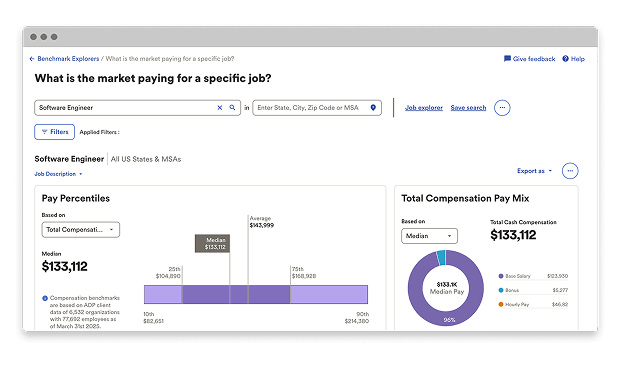
Workforce Now includes robust reporting tools with template reports, custom report builders, and the ADP Benchmarks feature, which lets you compare your workforce data against industry peers using ADP’s large customer dataset. For HR leaders who need to present workforce analytics to leadership, the benchmarking capability is genuinely useful and difficult to replicate without access to a dataset of comparable scale.
Where ADP Stands Out
Payroll and Tax Compliance Depth
ADP has been processing payroll for over 75 years. The tax compliance infrastructure, multi-state payroll handling, and year-end filing accuracy are among the most reliable in the industry. For organizations operating across multiple states with complex payroll scenarios (shift differentials, union rules, tipped employees, executive compensation), ADP’s depth here is hard to match at the mid-market level.
The Learning Library Is a Genuine Differentiator
70,000+ pre-built courses covering compliance topics, professional development, and industry-specific training is not something most HCM platforms offer at any price. For regulated industries where compliance training documentation is mandatory, having it built into the payroll platform rather than managing a separate LMS saves real administrative overhead.
Benchmarking Against Industry Peers
ADP serves more than one million client organizations. That dataset powers a benchmarking capability that lets HR leaders see how their compensation, turnover, and workforce metrics compare to peers in the same industry and geography. This is a unique advantage that smaller or newer platforms cannot replicate, and it is one of the more compelling reasons to choose ADP for organizations that take workforce analytics seriously.
Scale and Stability
ADP is a publicly traded company with decades of operational history, SOC certifications, and security infrastructure appropriate for enterprise-scale data. For payroll managers at organizations where data security and vendor stability are non-negotiable, ADP’s track record carries real weight. The risk of your payroll vendor going out of business or deprioritizing the product is effectively zero.
Where ADP Falls Short
Customer Support Is the Most Cited Complaint
This is the single most consistent criticism of ADP Workforce Now across G2, Capterra, and TrustRadius, and it has been for years. Long hold times, inconsistent representative quality, slow case resolution, and support that varies significantly based on which rep you reach appear in a disproportionate share of critical reviews. One long-time user on Capterra described holding on for hours and ultimately leaving despite loving the product.
Support during tax season is especially slow. Year-end, Q1 tax filing, and ACA reporting deadlines are the moments payroll managers most need responsive help. These are also the moments ADP support is most stretched. Build internal documentation for your most common workflows so you are not dependent on support for routine issues.
The Interface Feels Dated
ADP Workforce Now is a powerful platform, but its user interface reflects its age. Navigation requires more clicks than it should, reports are harder to run than users expect, and new administrators face a steep learning curve before the system feels intuitive. G2 reviews tag “not user-friendly” and “navigation difficulty” among the most common negative themes, with 98 and 72 mentions respectively.
ADP has been investing in UI improvements, and the mobile app has been updated in recent years with positive reception. But the desktop experience still trails more modern competitors like Paylocity and Rippling on ease of use.
Pricing Opacity and Add-On Costs
No published pricing. No self-serve trial. And a modular structure that means the initial quote often does not reflect what you actually end up paying once you add the modules your team needs. Multiple reviews describe discovering that key features (time tracking, advanced benefits reporting, analytics) are separate paid add-ons only after signing. The true cost of ADP is frequently higher than the number that appears in the initial sales conversation.
Limited Flexibility and Customization
ADP Workforce Now is a large, standardized platform. It tends to work best when your HR processes conform to ADP’s workflow structure, and less well when you need to customize workflows to match unusual organizational requirements. Users who need highly flexible approval chains, non-standard pay structures, or deeply customized reporting often find ADP’s rigidity frustrating compared to more configurable alternatives.
Not Well-Suited for Small Teams
The feature depth, pricing model, and implementation complexity all assume an organization large enough to justify the investment. For businesses under 50 employees, Workforce Now is genuinely oversized. The learning curve, cost, and support friction make alternatives like Gusto or Patriot Software a better fit until the team grows into mid-market complexity.
What Real Users Say
ADP Workforce Now holds approximately a 4.0/5 rating on G2, which is lower than most of its mid-market competitors including Paylocity (4.4) and Rippling. The gap largely reflects the customer support and interface complaints rather than payroll processing quality. On Capterra the sentiment is mixed in a similar pattern, with payroll reliability praised consistently and support frustrated consistently.
Common praise: Payroll accuracy and reliability receive consistent high marks. Users who come from fragmented systems frequently cite consolidation as a major win. The employee self-service portal and mobile app are praised for making basic HR tasks accessible without contacting HR. Long-term users (some with 10 to 17 years on the platform) frequently cite ADP’s ongoing improvement and breadth of features as reasons they stay despite frustrations.
Common complaints: Customer support is the dominant theme in critical reviews: long hold times, inconsistent rep quality, slow case resolution. The interface is described as clunky and unintuitive by a significant portion of administrators. Pricing surprises from add-on costs post-contract. Limited report customization. Navigation complexity that requires significant training time before users feel comfortable.
Who Should Use ADP Workforce Now
- Payroll managers at organizations of 75 to 750 employees who need a proven, deeply compliant payroll platform with multi-state support and a track record that reduces risk.
- HR teams replacing fragmented point solutions who want payroll, benefits, time tracking, and talent management under one roof with a single employee record.
- Organizations in regulated industries (healthcare, financial services, manufacturing) that need a substantial compliance training library and strong ACA and COBRA support built into the HCM platform.
- Companies that value vendor stability and security credentials above user experience modernity, where ADP’s scale and track record outweigh the interface and support trade-offs.
- Organizations already running ADP RUN that have grown past 50 employees and need a natural upgrade path within the ADP ecosystem without migrating to a different vendor entirely.
Who Should Not Use ADP Workforce Now
- Organizations under 50 employees. The pricing, complexity, and support model do not scale down well. Gusto, OnPay, or RUN Powered by ADP are better fits.
- Teams prioritizing a modern, intuitive user experience. Paylocity, Rippling, and BambooHR all deliver a more contemporary interface with a shorter learning curve.
- HR teams with limited bandwidth for implementation and training. ADP requires a significant time investment before it runs smoothly. Teams without dedicated HR or payroll administrators to own the system will struggle.
- Organizations that need responsive support as a baseline. If payroll issues require same-day resolution and your team does not have deep ADP knowledge internally, the support model will create real risk at critical moments.
- Companies with highly customized workflow requirements that do not conform to standard HR processes. ADP’s rigidity makes it a poor fit for unusual organizational structures.
ADP Workforce Now vs. Alternatives
| Platform | Best For | Starting Price | Key Difference |
|---|---|---|---|
| ADP Workforce Now | Mid-market teams valuing payroll depth and compliance track record | Custom (~$19 to $30 PEPM) | Industry’s deepest payroll compliance history; largest LMS library; weakest on support and UX |
| Paylocity | Mid-market teams wanting a modern HCM with employee engagement tools | Custom (~$22 to $32 PEPM) | More modern interface and stronger employee engagement; often cited as easier to use than ADP at comparable cost |
| Gusto | Small businesses under 50 employees | $40/month + $6/employee | Transparent pricing, fast setup, simpler interface; outgrown by most mid-market teams |
| Rippling | Tech-forward mid-market teams wanting HR and IT unified | Custom (~$8/employee/month base) | More modern platform with IT device management; stronger UX than ADP; smaller compliance track record |
| Deel | Teams with international contractors or employees | $49/contractor/month | Purpose-built for global payroll and EOR; ADP’s global offering relies on partner infrastructure |
Quick Pick Guide
- You have 75 to 750 employees and payroll compliance and tax accuracy are your top priority: ADP Workforce Now is worth evaluating seriously.
- You want a more modern platform at a comparable price point: Paylocity is the most common mid-market alternative to ADP, and frequently cited as easier to use with better support.
- You have under 50 employees and want simple payroll: Gusto is a better fit than Workforce Now, or evaluate RUN Powered by ADP if you want to stay in the ADP ecosystem.
- You need a significant compliance training library built into your HCM: ADP’s 70,000+ course LMS is a genuine differentiator that few competitors match.
- You are already on ADP RUN and growing past 50 employees: Upgrading to Workforce Now is a natural path that avoids a full data migration to a new vendor.
Popular Integrations
ADP Workforce Now connects to a wide range of third-party tools through the ADP Marketplace, which includes hundreds of pre-built integrations. Key integrations for HR and payroll teams include:
- Accounting: QuickBooks Online, QuickBooks Desktop, Xero, Sage Intacct, NetSuite
- Applicant tracking: Greenhouse, Lever, iCIMS, JazzHR, SmartRecruiters
- Benefits carriers: Direct carrier connections for major medical, dental, vision, and 401k providers
- Learning management: Absorb LMS, Cornerstone (via ADP’s native LMS or external connection)
- Communication: Slack, Microsoft Teams
- IT and security: Microsoft Azure AD, Okta (SSO and directory sync)
- Workforce management: Kronos, UKG (for organizations using ADP alongside a separate workforce management tool)
- Global payroll: Third-party in-country partners across 140+ countries
Frequently Asked Questions
How much does ADP Workforce Now cost for a 100-person company?
ADP does not publish pricing. Based on third-party estimates, a 100-person team on a standard feature set (payroll, benefits, time and attendance) would likely pay between $2,000 and $3,000 per month, plus a one-time implementation fee typically ranging from $10,000 to $20,000 on an annual contract of that size. These are estimates; your actual quote will depend on which modules you select and your negotiating position.
Is ADP Workforce Now worth it, or should I use Paylocity instead?
The honest answer: Paylocity is generally easier to use, has a more modern interface, and receives stronger customer support ratings. ADP Workforce Now wins on payroll compliance depth, the learning management library, and benchmarking capabilities. If you are choosing between the two, the decision often comes down to whether payroll complexity and compliance training depth justify the UX and support trade-offs that come with ADP. Many organizations switching from ADP to Paylocity cite support quality and interface as the primary reasons.
How long does ADP Workforce Now take to implement?
Mid-market HCM implementations typically run 3 to 6 months. ADP’s implementation timeline falls within that range. Plan for a data migration period, parallel payroll testing, and administrator training before going fully live. Do not skip parallel payroll testing. Multiple Capterra reviews describe data migration errors that surfaced on the first live payroll run.
Does ADP Workforce Now handle multi-state payroll?
Yes. Multi-state payroll, including automatic state and local tax table updates and jurisdiction-specific compliance requirements, is a core strength. This is one of the areas where ADP’s depth is most clearly superior to smaller competitors.
Can ADP Workforce Now handle global payroll?
ADP offers global payroll support in 140+ countries through in-country partners. For organizations with significant international hiring needs, Deel or Remote have stronger native global infrastructure. ADP’s global offering is functional but relies on third-party relationships rather than owned capabilities.
Does ADP Workforce Now integrate with QuickBooks?
Yes. QuickBooks Online and QuickBooks Desktop integrations are available, allowing payroll journal entries to export directly into the accounting platform. This is one of the more commonly used integrations for mid-market organizations that use QuickBooks alongside Workforce Now.
Is ADP Workforce Now HIPAA compliant?
ADP maintains security certifications including SOC 1 and SOC 2 compliance appropriate for handling sensitive employee data. For specific HIPAA requirements applicable to your use case, review ADP’s security documentation or contact their sales team directly, as compliance scope depends on how the platform is configured.
Does ADP offer a free trial?
No. ADP Workforce Now does not offer a self-serve free trial. Evaluation happens through a demo process with ADP’s sales team. Ask about requesting a sandbox or test environment during the negotiation process if you want to validate workflows before signing.
What is the difference between ADP Workforce Now Select, Plus, and Premium?
The three base tiers add features incrementally. Select covers core payroll and basic HR. Plus adds benefits administration. Premium adds full time and attendance including scheduling, time tracking, and accruals. Most mid-market organizations end up on Plus or Premium. Advanced features like analytics, learning management, and talent management are priced separately on top of the base tier.
How does ADP compare to Paychex?
Both are established mid-market payroll and HR platforms with similar pricing structures and modular feature sets. Paychex generally receives higher marks for customer support accessibility, including 24/7 phone support across more tiers. ADP’s payroll compliance depth and benchmarking capabilities are typically cited as advantages over Paychex. The choice between the two often comes down to support experience and specific feature requirements.
Is ADP right for a nonprofit organization?
ADP Workforce Now serves nonprofit organizations and can handle grant-based reporting and multi-entity payroll structures relevant to nonprofits. Ask the sales team about nonprofit pricing during your quote process. The compliance training library is also relevant for nonprofits with significant volunteer or staff training requirements.
What happens to my data if I leave ADP?
ADP provides data export tools that allow you to retrieve employee records, payroll history, and tax filings upon termination. Understand the data export format and timeline before signing, and confirm you will have access to historical records for the legally required retention periods after your contract ends.
Final Verdict
ADP Workforce Now earns its place as a go-to mid-market HCM platform based on genuine strengths: industry-leading payroll compliance depth, a substantial compliance training library, benchmarking capabilities built on an unmatched client dataset, and 75 years of operational history that deliver real vendor stability. These are not marketing claims; they are advantages that matter to payroll managers at organizations with complex, multi-state payroll requirements and HR teams that need compliance training built in.
The limitations are equally real and worth naming plainly. Customer support is the biggest risk factor: it is slow, inconsistent, and worst at the moments you need it most. The interface is dated and the learning curve is steep. Pricing opacity means you will not know the true cost until you are deep in a sales conversation. And the modular add-on structure means the initial quote understates what you will actually pay.
The decision framework is straightforward: if payroll compliance depth, compliance training, and vendor stability are your top priorities and you have the HR staffing to manage a complex system, ADP Workforce Now is a defensible choice. If you want a more modern experience, better support, or more transparent pricing, Paylocity is the most natural mid-market alternative to evaluate side by side before you commit.
Last updated on May 4, 2026