ADVERTISING DISCLOSURE: THIS POST CONTAINS AFFILIATE LINKS. READ FULL DISCLAIMER
The Verdict: Sage Intacct is the strongest cloud financial management platform for mid-market services businesses, nonprofits, and SaaS companies that have outgrown QuickBooks Online or Xero but do not need NetSuite’s full operational ERP scope. It excels at multi-entity consolidation, dimensional reporting, and project accounting. Pricing is quote-based and typically lands between $15,000 and $50,000 per year, making it a serious finance system investment.
Last updated May 2026.
In This Review
What Sage Intacct Is
Sage Intacct is a cloud-native financial management platform built for mid-market finance teams and the only financial management solution exclusively endorsed by the AICPA. It is optimized for deep financial functionality, not broad operational ERP coverage. Unlike NetSuite, Sage Intacct does not try to be a single platform for finance, inventory, CRM, and manufacturing. It focuses on what finance teams need (multi-entity consolidation, dimensional reporting, project accounting, revenue recognition, fund accounting) and integrates with specialized tools for everything else.
The businesses that adopt Sage Intacct have outgrown QuickBooks Online and Xero: services firms billing across projects, SaaS businesses managing subscription revenue under ASC 606, nonprofits tracking restricted funds, and multi-entity organizations consolidating across subsidiaries. Sage Intacct is one of the few platforms purpose-built to handle these workflows without forcing a jump to full ERP.
Sage Intacct is a true SaaS product: browser-based, multi-tenant, with quarterly updates and no on-premise option. Pricing is modular: a core financial system (general ledger, AP, AR, cash management, reporting) plus add-on modules for project accounting, fixed assets, revenue recognition, and budgeting.
Sage Intacct Pricing
Sage Intacct does not publish a public price list. All pricing is quote-based and negotiated through Sage or an authorized reseller, with costs driven by user count, module selection, entity count, and contract length. Based on industry reporting, here is what Sage Intacct typically costs in 2026:
| Cost Component | Typical Range | Notes |
|---|---|---|
| Base subscription (smallest deployment) | $10,000 to $15,000 per year | Core financials, limited users, single entity |
| Typical mid-market deployment | $15,000 to $50,000 per year | 5-15 users, 2-5 entities, 2-4 add-on modules |
| Per full named user | $400 to $800 per month | Business users and employee users priced lower |
| Add-on modules | $3,000 to $10,000+ per module annually | Project accounting, fixed assets, revenue recognition, etc. |
| Implementation (one-time) | $15,000 to $75,000+ | Varies by complexity, data migration, and customization |
What drives the price: User count and entity count are the biggest variables, followed by module selection. Project accounting, fixed assets, revenue recognition, and advanced reporting are each separate line items, and most mid-market deployments need two or three beyond the core. Implementation is a real one-time cost worth planning for explicitly.
Nonprofit pricing: Nonprofit deployments typically start at $15,000 to $25,000 per year for the core platform, with additional costs for fund accounting and donor reporting modules. Sage Intacct offers a dedicated nonprofit edition with fund accounting built in.
Key Features
Multi-Entity Consolidation
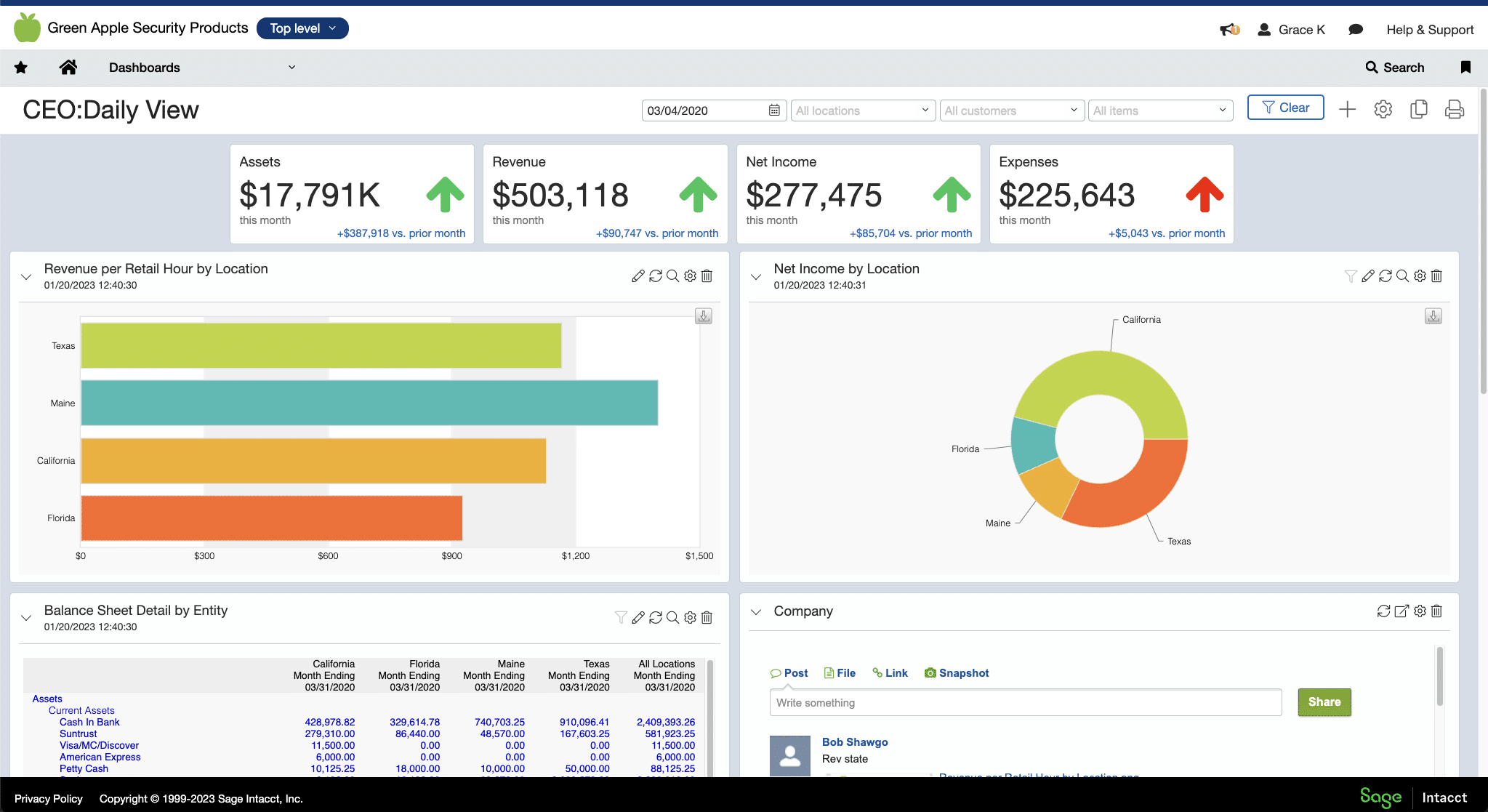
Multi-entity consolidation is one of Sage Intacct’s signature capabilities. The platform handles consolidations across legal entities, currencies, and tax jurisdictions natively, with drill-down into any subsidiary, automated intercompany transactions, and multi-entity reports in minutes. For organizations with five or more subsidiaries, this alone can justify the platform.
Dimensional Reporting
Sage Intacct uses a dimensional model instead of a flat chart of accounts. You tag transactions with dimensions (location, department, project, customer, vendor, employee, item) and slice reports across any combination without rebuilding the chart of accounts. This is the feature most finance teams point to when explaining why they moved off QuickBooks.
Project Accounting
Project accounting is a separate module but a primary driver of Sage Intacct adoption for services businesses. It handles project budgets, time and expense capture, billing rules (fixed fee, time and materials, milestone-based), revenue recognition by project, and profitability reporting at the project, client, or service-line level.
Revenue Recognition and Subscription Billing
Sage Intacct includes ASC 606 and IFRS 15 compliant revenue recognition with automated schedules for subscription, milestone, and percentage-of-completion models. The Contract and Revenue Management module handles SaaS billing scenarios including renewals, upgrades, downgrades, and proration. This is a primary reason SaaS finance teams choose Intacct over alternatives that require bolt-on revenue tools.
Fund Accounting for Nonprofits
Sage Intacct’s nonprofit edition includes purpose-built fund accounting: restricted versus unrestricted fund tracking, grant management with budget-to-actual reporting, donor management integration, and compliance reporting. This is a genuine differentiator against NetSuite, which handles nonprofit accounting through general configuration rather than dedicated functionality.
Where Sage Intacct Stands Out
Best-in-Class Multi-Entity Financials
Sage Intacct’s consolidation capabilities are among the strongest in the mid-market. Consolidations that take days in QuickBooks Online Advanced or require third-party tools in Xero happen natively. Intercompany eliminations, currency translation, and parent-subsidiary reporting work the way finance teams actually need.
Dimensional Reporting That Scales
The dimensional reporting model scales far better than sub-account-based systems. Adding a new office, service line, or product category does not require restructuring the chart of accounts. For finance teams that have hit the limits of flat reporting in QuickBooks or Xero, this alone often justifies the platform change.
AICPA Endorsement and Accountant Adoption
Sage Intacct is the only financial management platform exclusively endorsed by the AICPA, and that endorsement reflects real adoption among accounting firms. The platform is supported by a strong certified consultant network and respected by external auditors. For organizations working closely with CPAs or undergoing regular audits, this professional credibility matters.
Services and Nonprofit Specialization
Sage Intacct is purpose-built for two segments other mid-market platforms handle less well: professional services and nonprofits. Both verticals have dedicated industry editions rather than configuration workarounds, with native project accounting for services and fund accounting for nonprofits.
Where Sage Intacct Falls Short
Limited Operational ERP Capabilities
Sage Intacct is a financial management system, not a full ERP. Inventory management is basic, and there is no native CRM, e-commerce, manufacturing, or warehouse management. Organizations needing these capabilities must integrate specialized tools, adding cost and integration maintenance. For product-based businesses, NetSuite’s all-in-one architecture is usually a better fit.
Costs Add Up Quickly
The modular pricing structure means the headline base subscription rarely reflects real total cost. Project accounting, fixed assets, revenue recognition, and additional entities each add to the annual bill. Reviewers consistently flag that costs escalate at renewal. A deployment that starts at $20,000 per year often lands closer to $40,000 to $60,000 once necessary modules are included.
Implementation Is a Real Project
Sage Intacct implementations typically take three to six months and require internal expertise or a partner consultant. Chart of accounts design, dimensional structure setup, data migration, integrations, and user training all need real time. Organizations that underestimate implementation frequently end up with a partially configured system that does not deliver the value they paid for.
User Interface and Learning Curve
Sage Intacct is built for finance professionals, and the interface reflects that audience: functional and capable rather than intuitive. New users coming from QuickBooks or Xero face a steep learning curve, and onboarding non-finance team members for expense or approval workflows requires real training.
Account Management Concerns at Smaller Deployments
Capterra reviews from smaller customers (under $20 million in revenue) flag aggressive account management practices around renewals and pricing increases. Several reviewers report being pushed to sign new agreements with higher costs mid-contract. This appears less common for larger customers but is worth understanding before signing.
What Real Users Say
Sage Intacct holds a 4.3 out of 5 rating on G2 across more than 4,000 reviews and a similar score on Capterra, making it one of the highest-rated mid-market financial platforms. Feedback skews positive among finance professionals, with more mixed reactions from non-finance users.
Common praise: Finance teams praise the depth of dimensional reporting and the speed of multi-entity consolidation. Bank reconciliation and journal workflows are described as efficient. Customization for account structures and reports gets strong marks, and integration with Salesforce, ADP, and expense management tools is called out as smooth.
Common complaints: Cost is the most consistent criticism, particularly module fees and per-user pricing that escalate at renewal. The learning curve for new users is flagged across reviews, with some describing the system as overcomplicated for simple tasks. Account management at smaller deployments draws negative feedback, and volume data exports have reported limitations.
Independent analysts generally agree Intacct is stronger for finance-first organizations and NetSuite better for operations-heavy businesses. NetSuite’s comparison materials highlight Intacct’s higher per-user license cost and additional charges for subsidiaries and APIs, though Intacct’s focused scope often keeps total cost lower for finance-only deployments.
Who Should Use Sage Intacct
- Mid-market services businesses (consulting firms, agencies, professional services organizations) that need project accounting, time and expense capture, and profitability reporting by project or client.
- SaaS and subscription businesses managing ASC 606 revenue recognition, complex billing scenarios, and recurring revenue analytics.
- Multi-entity organizations consolidating financials across subsidiaries, currencies, or geographies that have outgrown QuickBooks consolidation capabilities.
- Nonprofits with fund accounting requirements, grant management needs, and donor reporting workflows.
- Growing finance teams at companies with $5 million to $250 million in annual revenue that need professional-grade financial management without committing to full operational ERP.
- Organizations working closely with CPAs or undergoing regular external audits who benefit from the AICPA endorsement and accountant familiarity with the platform.
Who Should Not Use Sage Intacct
- Small businesses under $5 million in revenue. The cost and implementation effort are significant overkill. QuickBooks Online or Xero serve this segment better at a fraction of the cost.
- Product-based businesses with real inventory complexity. Sage Intacct’s inventory module is basic. NetSuite or a dedicated inventory ERP is a better fit.
- Organizations needing full operational ERP. If you need CRM, e-commerce, manufacturing, or warehouse management on a single platform, NetSuite delivers that scope; Intacct requires integrations.
- Buyers expecting self-serve setup. Implementation requires real planning, expertise, and time. This is not a tool you buy on Friday and launch on Monday.
- Enterprises above $250 million in revenue with complex global operations. Larger enterprises may find Intacct’s scope limiting and benefit more from NetSuite, Oracle ERP Cloud, or SAP.
Sage Intacct vs. Alternatives
| Platform | Best For | Starting Price | Key Difference |
|---|---|---|---|
| Sage Intacct | Mid-market services, SaaS, nonprofits, multi-entity | ~$15,000/year | Finance-first cloud platform; deep dimensional reporting; AICPA-endorsed |
| NetSuite | Mid-market product businesses, full ERP needs | ~$25,000+/year | All-in-one ERP with native CRM, inventory, e-commerce, manufacturing |
| QuickBooks Online Advanced | Small to lower-mid-market, single-entity businesses | $235/month | Easier to use, far cheaper, but limited multi-entity and dimensional reporting |
| Xero | Small businesses, multi-user teams | $20/month | Cloud-native, unlimited users, but limited consolidation and project accounting |
| Sage 50 | Inventory-heavy SMBs, desktop preference | $69.42/month | Sage’s desktop SMB product; very different audience and architecture |
Quick pick guide:
- You are a services firm, SaaS company, or nonprofit needing dimensional reporting and multi-entity consolidation: choose Sage Intacct
- You are a product-based mid-market business needing inventory, CRM, and e-commerce on one platform: choose NetSuite
- You are growing past QuickBooks but not yet ready for mid-market financial software: stay on QuickBooks Online Advanced
- You need multi-user cloud accounting at a lower price point: choose Xero
- You need desktop accounting with inventory depth and prefer local data: choose Sage 50
Popular Integrations
Sage Intacct’s integration ecosystem includes more than 350 pre-built integrations and a marketplace covering most major business systems. Because Intacct is finance-focused rather than full ERP, integrations are often essential to extend the platform into operations, CRM, and HR.
Salesforce (native): The flagship integration. Bi-directional sync covers opportunities to invoices, customer master data, and revenue reporting. This is a primary reason SaaS companies choose Intacct.
Payroll and HR: Native integrations with ADP and Sage People for journal posting and employee master data sync.
Expense Management: Native integrations with Expensify, SAP Concur, and Tallie.
AP Automation: Sage AP Automation (native) handles invoice capture, approval workflows, and electronic payments. Bill.com, Tipalti, and AvidXchange are also widely deployed.
FP&A and Budgeting: Vena, Workday Adaptive Planning, and Planful integrate for advanced budgeting, forecasting, and financial modeling beyond Intacct’s native capabilities.
Sage Intacct Marketplace: The full marketplace includes hundreds of additional integrations covering industry tools, document management, banking, payments, and analytics. Quality varies by partner.
Frequently Asked Questions
How much does Sage Intacct cost per year?
Sage Intacct does not publish public pricing. Typical deployments fall between $15,000 and $50,000 per year, with smaller configurations starting around $10,000 to $15,000 and larger multi-entity deployments running $50,000 to $100,000+ annually. Implementation is a separate one-time cost typically $15,000 to $75,000.
Is Sage Intacct better than QuickBooks?
They serve different markets. QuickBooks Online is built for small businesses. Sage Intacct is built for mid-market finance teams needing multi-entity consolidation, dimensional reporting, and project accounting. If your team is hitting QuickBooks limits (slow consolidations, limited reporting, manual project profitability workarounds), Intacct is a meaningful upgrade. If QuickBooks is meeting your needs, Intacct is overkill.
Sage Intacct vs. NetSuite: which is better?
The answer depends on whether you need a finance system or an operational ERP. Sage Intacct is stronger for services businesses, SaaS companies, and nonprofits where the core need is financial depth. NetSuite is stronger for product-based businesses that need inventory, CRM, e-commerce, and manufacturing on one platform. Sage Intacct’s per-user fees can be higher, but it often costs less overall for finance-only deployments.
Does Sage Intacct offer a free trial?
No. Sage Intacct offers product tours, guided demos, and proof-of-concept evaluations through its sales team or authorized partners, but there is no self-serve free trial.
How long does Sage Intacct implementation take?
Typical implementations run three to six months, with simpler deployments completing in two to three months and complex multi-entity implementations taking six to nine months. Timelines depend on chart of accounts design, dimensional structure setup, data migration scope, and integration requirements.
Does Sage Intacct handle nonprofit fund accounting?
Yes. Sage Intacct’s nonprofit edition includes built-in fund accounting, restricted versus unrestricted fund tracking, grant management with budget-to-actual reporting, and donor management integration. It is often selected over QuickBooks Nonprofit for organizations with meaningful grant or fund complexity.
Can Sage Intacct handle SaaS revenue recognition?
Yes. The Contract and Revenue Management module supports ASC 606 and IFRS 15 compliant revenue recognition for subscription, milestone, and percentage-of-completion models, handling renewals, upgrades, downgrades, and deferred revenue schedules automatically.
Is Sage Intacct the same as Sage 50?
No. Sage 50 is desktop accounting software for small businesses (Windows-only). Sage Intacct is a cloud-native financial management platform for mid-market organizations. They share the Sage brand but are entirely different products with different architectures and target buyers.
How does Sage Intacct handle multi-entity consolidation?
Multi-entity consolidation is a core capability rather than an add-on. The platform handles consolidation across legal entities, currencies, and tax jurisdictions with automated intercompany eliminations, currency translation, and parent-subsidiary reporting. Consolidations run in minutes rather than days.
Final Verdict
Sage Intacct earns its position as the leading finance-first cloud platform in the mid-market by doing a small number of things exceptionally well: multi-entity consolidation, dimensional reporting, project accounting, and revenue recognition. For services firms, SaaS companies, nonprofits, and multi-entity operators, these capabilities address real pain points lower-tier cloud accounting cannot.
The trade-offs are real. Total cost frequently exceeds initial expectations once modules are factored in. Implementation requires planning and either internal expertise or a partner consultant. The interface is built for finance professionals, not casual users.
The honest framing: Sage Intacct is for finance teams that have already hit the limits of QuickBooks or Xero and need a platform that can support multi-entity reporting, project profitability, or compliant revenue recognition without compromise. For that audience, it is one of the strongest options in the market.
Visit Sage Intacct Official Site
Last updated on May 29, 2026