ADVERTISING DISCLOSURE: THIS POST CONTAINS AFFILIATE LINKS. READ FULL DISCLAIMER
Last updated: May 2026
Quick verdict: Westlaw is the gold standard for U.S. legal research and has been for decades. Its proprietary KeyCite citator remains the deepest signal-flagging tool on the market, its secondary materials (treatises, practice guides, Practical Law) are unmatched, and its AI features now run from Westlaw Edge with AI-Assisted Research up to Westlaw Precision with CoCounsel. The catch is price. Westlaw Classic starts at roughly $132 per month for a single-state plan, but full national access with AI features can run $400 per user per month or more. For large firms with billable research recovery, Westlaw is worth the premium. For solos with predictable practice areas, Fastcase at $65 per month often covers 80 percent of the work for 20 percent of the cost.
What Westlaw Is
Westlaw is Thomson Reuters’ flagship legal research platform and the longest-running commercial legal database in the United States. Tracing its lineage to West Publishing’s printed case reporters in the late 1800s, the modern platform covers case law, statutes, regulations, court rules, secondary sources, treatises, dockets, public records, and (since 2024) deeply integrated generative AI.
The current product hierarchy has four main tiers: Westlaw Classic (the baseline research platform), Westlaw Edge (Classic plus advanced KeyCite features and litigation analytics), Westlaw Edge with AI-Assisted Research (Edge plus natural-language AI search and AI Jurisdictional Surveys), and Westlaw Precision with CoCounsel (the top tier, bundling the full CoCounsel AI suite with Westlaw’s research database). A newer Westlaw Advantage tier sits at the top with agentic Deep Research capabilities. Westlaw is the premium incumbent in U.S. legal research, and whether the premium is justified for your firm depends almost entirely on practice area, billable rate, and research volume.
Who Westlaw Is For
Westlaw fits four distinct profiles, and the buying decision hinges on which describes your practice.
Large firms with billable research recovery. If your firm bills clients for research time at $250 to $750 per hour, Westlaw’s premium pricing is functionally invisible. Associates running 5 to 10 research sessions per day generate enough billable hours to pay for the subscription many times over, and KeyCite’s signal depth meaningfully reduces the risk of citing bad law in a brief. For AmLaw 200 firms and large regional practices, Westlaw is the default.
Mid-size litigation firms with complex commercial work. Firms in the 10 to 50 attorney range doing commercial litigation, appellate work, or complex regulatory practice typically need the depth Westlaw provides. The platform’s secondary sources (Wright and Miller, Moore’s Federal Practice, Couch on Insurance, the various Restatements) and proprietary treatises remain genuinely difficult to replicate elsewhere.
Corporate and government legal departments. In-house legal at large companies and government legal departments often use Westlaw because it integrates with broader Thomson Reuters offerings (Practical Law, Westlaw Edge for Corporate, Tax & Accounting). Volume contracts are often part of multi-product enterprise agreements.
Specialty practice areas with publisher-specific content. If your practice depends on specific Thomson Reuters publications (Federal Practice and Procedure, jurisdiction-specific deskbooks, certain treatise series), Westlaw is functionally non-substitutable.
Westlaw is often a poor fit for solo practitioners with general practice work, small firms where research is occasional rather than central, lawyers who can recover most of what they need through their bar association’s Fastcase benefit, and high-volume transactional practices that rarely cite case law beyond a narrow set of authorities.
Pricing
Westlaw’s pricing is layered, contract-driven, and notoriously opaque at higher tiers. Figures below are the most current published rates from third-party sources and library cost guides; final pricing is negotiated and varies by firm size, state coverage, contract length, and add-ons.
Westlaw Classic
The baseline research tier covers case law, statutes, KeyCite, and court rules. Published rates start around $132 per month per user for a single-state plan on an annual contract. All-states primary law runs roughly $200 per month, and all-states plus federal primary law starts around $266 per month. Secondary sources, dockets, and analytics are typically priced as add-ons.
Westlaw Edge
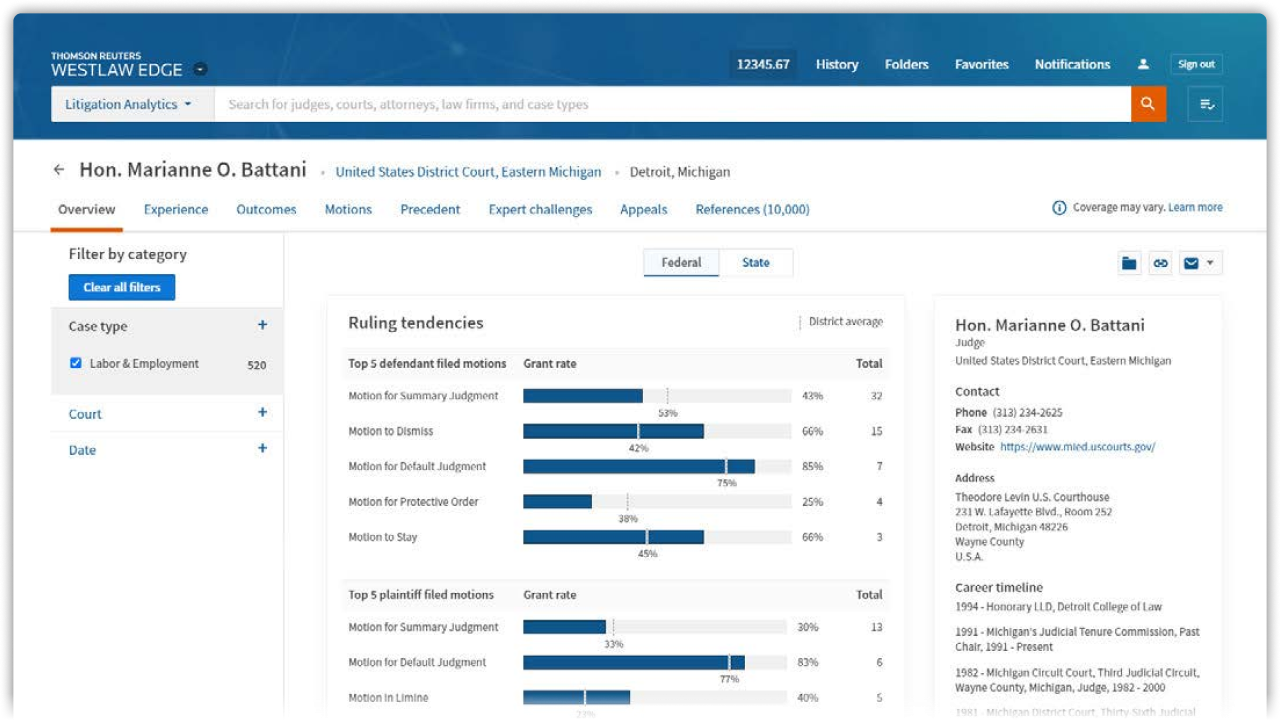
Edge adds KeyCite Overruling Risk (which flags cases implicitly undermined by overruled authority), Litigation Analytics (judge, court, and attorney data), Statutes Compare (side-by-side statutory version comparison), and Quick Check (AI-powered brief analysis). Pricing starts around $194 per month for a single state. Mid-size firms negotiating Edge typically land in the $250 to $400 per user per month range with reasonable content add-ons.
Westlaw Edge with AI-Assisted Research
The first AI-enabled tier adds natural-language research queries that return summarized answers with verifiable Westlaw citations. It also includes AI Jurisdictional Surveys for rapid 50-state research. Pricing is quote-only; reports from firms suggest AI features add roughly $150 to $300 per user per month on top of an existing Edge subscription.
Westlaw Precision with CoCounsel
The premium tier bundles Westlaw with the full CoCounsel AI suite, which Thomson Reuters acquired from Casetext for $650 million in 2023 and has since integrated deeply. Reported pricing runs around $428 per user per month for solo practitioners on annual contracts. Firm-tier pricing scales from there and remains quote-only. The bundle includes Deep Research (agentic memo generation), Brief Analyzer, document analysis, and timeline creation.
Westlaw Advantage
The newest top-tier offering adds Deep Research with agentic AI that builds and executes multi-step research plans, and a Litigation Document Analyzer for full-document analysis. Pricing is quote-only and typically pitched to AmLaw firms.
Hidden costs to expect
Beyond headline tier prices, common surprises include off-plan document charges (per-document fees for content outside your plan), document delivery fees, costly add-ons for secondary sources and treatises, and annual contract lock-ins with significant early-termination penalties. The published “Westlaw Predictable Pricing” of $99 per search is a suggested client billback rate, not an actual subscription cost.
Where Westlaw Stands Out
KeyCite remains the deepest citator on the market
KeyCite is the single biggest reason firms stay on Westlaw. Its signal flags (red, yellow, blue, and the newer Overruling Risk indicator) are more granular and more reliable than competitors, particularly for tracking implicit overruling and depth of negative treatment. For appellate litigation and complex commercial cases where citing bad law is malpractice-adjacent, KeyCite’s depth is genuinely irreplaceable.
Secondary materials are unmatched in U.S. legal research
Thomson Reuters owns the most comprehensive library of U.S. legal treatises and practice guides in the industry. Wright and Miller’s Federal Practice and Procedure, Moore’s Federal Practice, the Restatements of Law, Williston on Contracts, Nimmer on Copyright, McCarthy on Trademarks, Corbin on Contracts, and dozens of jurisdiction-specific deskbooks are exclusive or near-exclusive to Westlaw. For lawyers who rely on these as core references, no other platform meaningfully competes.
Practical Law integration is a major differentiator
Practical Law provides practice notes, standard documents, checklists, and toolkits covering most major practice areas with content maintained by experienced practitioner-editors. It is genuinely useful for transactional work and one of the few content products competitors have struggled to match. The integration with Westlaw research makes the combined product especially strong for transactional and regulatory practices.
AI features ground every citation in real authority
The killer advantage of Westlaw’s AI is that every cited authority is verifiable because it comes from Westlaw’s actual database, not generated from a language model’s training data. Quick Check, Brief Analyzer, AI-Assisted Research, and Deep Research all anchor outputs to real cases with KeyCite signals automatically applied. This is a meaningful differentiator versus general-purpose AI tools that hallucinate citations.
Where Westlaw Falls Short
Pricing transparency is poor at every tier
Westlaw publishes some entry pricing for solo and small firms but quotes everything else opaquely. Firm-tier pricing, AI add-on pricing, secondary source pricing, and enterprise contracts are all sales-driven. Buyers routinely encounter pricing surprises in renewal negotiations, off-plan charges, and add-on creep. For a platform that competes on premium positioning, the lack of public pricing puts buyers at a structural disadvantage.
Total cost is genuinely high for most small firms
Even at the published Classic tier ($132 per month for a single state), most lawyers need broader coverage, which pushes real costs to $250 to $400 per user per month before AI. Add CoCounsel and Practical Law and a small firm can easily spend $500 to $700 per user per month. For firms billing $200 to $400 per hour, the math is workable. For firms with lower billing rates or where research is occasional, the cost is hard to justify against alternatives like Fastcase at $65 per month.
Contract lock-in is a real risk
Westlaw contracts typically run for one to three years with material early-termination penalties. Several documented reviews describe firms unable to exit contracts even after deciding the product no longer fits their needs. Buyers should negotiate exit terms upfront and understand off-plan charge mechanics before signing.
AI privacy considerations for document uploads
Westlaw’s document analysis features (Quick Check, Brief Analyzer, CoCounsel document review) require uploading documents to Thomson Reuters’ cloud servers for processing. For firms handling highly sensitive matters or working under strict client confidentiality requirements, this raises privilege and data-handling questions that should be reviewed with IT and risk before broad adoption.
Integration with practice management is limited
Westlaw does not directly integrate with most cloud-based law practice management platforms. Compared to Fastcase‘s integration with Clio (now its parent company), Westlaw’s integration story is thinner, and the platform remains primarily a destination tool rather than embedded in drafting workflows.
Westlaw vs Lexis, Fastcase, and AI Research Platforms
| Feature | Westlaw | Lexis+ AI | Fastcase | Bloomberg Law |
|---|---|---|---|---|
| Entry price | $132 mo (single state) | Quote only | $0 via bar / $65 standalone | Quote only |
| Premium tier | $400 to $700+ mo with AI | $200 to $500+ mo | $399 mo Vincent AI | $450+ mo typical |
| Citator | KeyCite (deepest) | Shepard’s | Cert (editorial + algorithmic) | BCite |
| AI assistant | AI-Assisted Research + CoCounsel | Lexis+ AI / Protege | Vincent AI | Bloomberg Law AI |
| Secondary materials | Deepest (TR treatises) | Deep (RELX treatises) | Moderate (growing) | Strong (transactional focus) |
| Practical guidance | Practical Law (best in class) | Practical Guidance | Limited | Bloomberg Practice Centers |
| Pricing transparency | Partial (entry tier public) | Opaque | Strong (entry tier public) | Opaque |
The short version: Westlaw wins on citator depth, secondary materials, and practical guidance; Fastcase wins on price; Lexis runs neck-and-neck on most dimensions; Bloomberg Law leads on transactional and regulatory work. For AI workflows specifically, Harvey AI targets the highest end of big-law and Paxton AI targets accessible solo/small-firm pricing.
Final Verdict
Westlaw remains the premium incumbent in U.S. legal research, and for most large and mid-size firms doing substantive litigation, regulatory, or complex transactional work, it is genuinely worth the price. KeyCite, Practical Law, and the depth of Thomson Reuters’ treatise library are real competitive advantages competitors have spent decades trying to match.
For solo practitioners and small firms, the calculation is harder. Westlaw’s quality is not the question; the price is. A solo doing general practice work in one state with bar association Fastcase access and reasonable Google Scholar habits can often cover 80 percent of their research needs at zero or near-zero marginal cost. The remaining 20 percent (deep citator analysis, specific treatises, complex multi-jurisdiction research) sometimes justifies a Westlaw subscription, and sometimes does not.
The AI tier is the most interesting recent development. Westlaw Precision with CoCounsel is the most polished AI legal research product on the market, with grounded citations and KeyCite verification. At $428 per user per month for solos, it is also the most expensive. Whether the premium is justified depends on how much associate or attorney time it saves at your billing rates. Pilot before committing and negotiate aggressively on exit clauses and off-plan charges.
This is informational only, laws vary by jurisdiction, and you should consult a qualified attorney for advice specific to your matter.
Frequently Asked Questions
How much does Westlaw actually cost?
Published rates start at $132 per month for single-state Westlaw Classic on an annual contract. All-states primary law starts at $200 per month, and all-states plus federal starts around $266 per month. Westlaw Edge runs roughly $194 to $400 depending on coverage. Westlaw Precision with CoCounsel runs around $428 per user per month for solos, with firm pricing quote-only.
What is KeyCite and is it really better than Shepard’s?
KeyCite is Westlaw’s citator, which flags cases that have been overturned, criticized, or otherwise treated negatively. Most researchers consider KeyCite slightly deeper than Lexis Shepard’s, particularly with the Edge-tier Overruling Risk feature. Both are excellent, and the practical difference is narrow for most use cases, but at the appellate and complex commercial litigation level, KeyCite still has a small edge.
Is Westlaw Precision worth the upgrade over Westlaw Edge?
Depends on AI workflow volume. Precision adds the full CoCounsel suite (document review, contract analysis, deposition prep, timeline creation, Deep Research memos) on top of Edge. For litigation teams handling multiple complex matters, the time savings often justify the premium. For research-only practices, Edge with AI-Assisted Research may cover most needs at a meaningfully lower cost.
Can a solo practitioner afford Westlaw?
Yes, but it requires careful tier selection. A solo can subscribe to single-state Westlaw Classic for around $132 per month, which is affordable if research is central to the practice. The challenge is that most solos need broader coverage and add-ons, pushing real costs to $250 or more. For solos with bar association Fastcase access, paying Westlaw on top of free Fastcase needs clear justification.
How does Westlaw compare to Lexis on price?
The two are roughly comparable at every tier. Lexis publishes even less pricing than Westlaw, but reports suggest similar ranges: $200 to $400 per user per month for mid-tier plans and $400 to $700 for AI-enabled premium tiers. Negotiation matters more than list price for both vendors.
Does Westlaw integrate with practice management software?
Westlaw does not directly integrate with most cloud-based practice management platforms. Word and browser plug-ins are available, but Westlaw remains primarily a destination tool. This is a real gap versus Fastcase, which now sits under Clio and is being integrated into the broader Clio platform.
What is CoCounsel and how does it relate to Westlaw?
CoCounsel is the AI assistant Thomson Reuters acquired from Casetext in 2023 for $650 million. It handles document review, contract analysis, deposition preparation, and timeline creation. CoCounsel can be purchased standalone ($220 to $500 per month) or bundled with Westlaw as Westlaw Precision with CoCounsel at $428 per month. The bundled version provides the most seamless workflow.
Are there hidden costs in Westlaw contracts?
Yes. The most common surprises are off-plan document charges, document delivery fees, add-on costs for secondary sources and treatises, and early-termination penalties on annual contracts. Clarify all these mechanics in writing before signing and negotiate exit terms upfront.
Can I cancel Westlaw and switch to Fastcase or another platform?
Many firms have. The practical question is whether your practice can absorb the loss of specific treatises and Practical Law content. General practice, family law, employment, and most small-firm litigation translates well to Fastcase. Heavy commercial litigation with deep KeyCite dependencies, IP work requiring proprietary treatises, and specialized practice areas may still need Westlaw.
Should I trust Westlaw’s AI output without verification?
Always verify AI-generated legal research against primary sources, regardless of platform. Westlaw’s AI features ground citations in real authority and apply KeyCite signals automatically, which substantially reduces hallucination risk versus general-purpose AI tools. Professional responsibility rules in most jurisdictions require attorneys to verify the accuracy of any legal research they rely on. Treat AI output as a sophisticated starting point, not a final answer.Last updated on May 11, 2026