ADVERTISING DISCLOSURE: THIS POST CONTAINS AFFILIATE LINKS. READ FULL DISCLAIMER
Last updated: May 2026
Quick verdict: Lexis+ with Protégé is the enterprise legal AI platform for firms that want LexisNexis content authority paired with agentic workflows. The February 2026 rebrand replaced Lexis+ AI with a deeper workflow layer, and the May 2026 expansion added agentic drafting, secure workrooms, and customer-held encryption keys. If your firm already runs on Lexis and wants AI that stays anchored in Shepard’s-verified content, this is the natural upgrade. If you don’t have a LexisNexis subscription, the platform is rarely a starting point.
What Lexis+ with Protégé Is
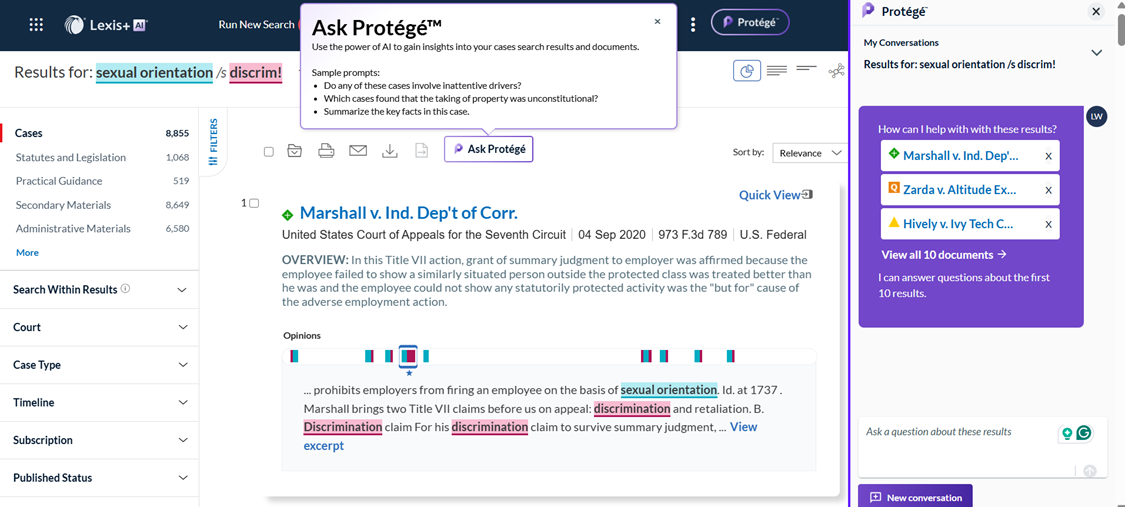
Lexis+ with Protégé is the flagship legal AI platform from LexisNexis, launched in February 2026 as the full replacement for Lexis+ AI. The platform combines LexisNexis’s content library (which the company describes as containing more than 200 billion documents) with an agentic AI layer that can plan and execute multi-step legal work rather than just answering single prompts.
The core pitch is integration. Instead of switching between research, drafting, and review tools, attorneys work through a single conversational interface that draws on Shepard’s Citations for verification, firm knowledge for context, and a library of more than 300 pre-built workflows for repeatable tasks. The platform was built in partnership with Anthropic, with LexisNexis-developed skills sitting on top of foundation models.
The May 2026 expansion layered six additional components onto the base platform, most notably Protégé Agentic Drafting for contracts, motions, and briefs, and Protégé Workrooms for secure collaboration between firms, clients, and co-counsel. The platform competes most directly with Thomson Reuters CoCounsel (the Westlaw-grounded equivalent) and increasingly with Harvey AI at the AmLaw deployment level.
Where Lexis+ with Protégé Stands Out
Shepard’s-grounded verification is the moat
Every other legal AI vendor has to answer the same question: how do you stop the model from hallucinating citations? LexisNexis’s answer is Shepard’s Citations, the citation-verification service it has operated for decades. Outputs from Protégé are cross-checked against Shepard’s to flag whether cases are still good law, and the May 2026 release added Shepard’s Verify Trust Markers, which flag AI-generated or attorney-drafted citations that cannot be verified against LexisNexis sources.
This matters because citation hallucinations are the single biggest legal-malpractice risk with general-purpose AI, and judges have already sanctioned attorneys for filing briefs with fabricated cases. Tools like Casetext CoCounsel ground in Westlaw; tools like Harvey AI lean on firm content and curated sources. Protégé’s bet is that Shepard’s-grade citation infrastructure is the strongest defensible position in the category.
The agentic framework is a real shift, not a marketing line
The May 2026 release introduced Protégé Work, which the company describes as a skills-and-orchestration layer. Functionally, this means a user can describe a goal in natural language (“compare these two NDAs against our playbook and flag deviations”), and Protégé will present a structured plan before executing, route the work through the appropriate skills, and produce a review-ready output in Word, Excel, PowerPoint, or PDF.
This is more useful than it sounds. Most legal AI tools to date have been one-shot prompt boxes sitting alongside a researcher’s existing workflow. Protégé’s plan-then-execute model is closer to how attorneys actually break down complex matters, and the structured plan gives the lawyer a chance to intervene before the AI commits to an approach.
Protégé Vault and Workrooms address real firm concerns
Vault now supports up to 100,000 documents per workspace and accepts audio, video, and image files alongside text. For document-heavy matters (due diligence, discovery review, internal investigations), this removes the awkward step of chunking files across multiple AI sessions.
Workrooms are the more interesting addition. They provide permission-aware shared spaces where firms, clients, and co-counsel can collaborate on documents, drafts, and AI workflows with role-based access and audit trails. For firms used to swapping documents over email or shared NetDocuments folders, this is a more controlled middle ground that keeps AI workflows inside the same governance boundary as the underlying files.
Enterprise security controls are genuinely deep
The May 2026 release added Protégé BYOK (Bring Your Own Key), which lets customers hold their own encryption keys. LexisNexis says this is already deployed in AmLaw 100 firms. Combined with the existing posture that customer inputs are not used to train LLMs, and the role-based controls in Workrooms, the platform is positioned for the most security-sensitive deployments. This is a category where Harvey AI and CoCounsel are also strong, but it is a meaningful answer to general counsel concerns about firm-confidential data leaving the perimeter.
Where Lexis+ with Protégé Falls Short
Pricing is opaque and almost always tied to a Lexis subscription
There is no public pricing for Protégé. The platform is sold through enterprise sales, and in practice it is almost always layered onto an existing LexisNexis subscription rather than purchased standalone. For firms already on Lexis, this is a contract amendment. For firms on Clio with Fastcase, or on Westlaw, the switching cost is significant and rarely justified by Protégé alone.
This is the single biggest commercial barrier. The platform is excellent if you are already a Lexis customer; it is rarely the deciding factor for firms shopping legal research from scratch.
The agentic framework is new and still maturing
The Protégé Work layer launched in May 2026, and while the demo flows are impressive, this is genuinely first-generation agentic legal AI in production. Real-world performance on novel matter types, edge cases, and unusual jurisdictions is still being established. Firms running pilot programs are reporting strong results on contract comparison and research synthesis, but the agentic drafting capability is newer and likely to evolve through 2026.
For risk-averse practice areas (regulatory, litigation, complex transactions), it is worth treating Protégé as a reviewer-assist tool rather than a finished-work generator until your firm has built internal confidence in its outputs for your specific use cases.
Implementation requires real internal investment
The platform’s strength (300+ workflows, no-code builder, firm-specific skills) is also its complexity. Getting full value requires configuring workflows to firm templates, training attorneys on the skill selection model, and building internal governance around when to use which skill. LexisNexis offers a white-glove implementation service for larger deployments, but smaller firms should expect a real ramp period before adoption hits its stride.
This is not unique to Protégé. Every enterprise legal AI platform has a similar curve, but it does mean the platform rewards firms with internal champions more than firms expecting plug-and-play utility.
Global rollout is still in progress
The May 2026 expansion launched in the U.S. first, with global markets rolling out throughout the rest of 2026. Firms outside the U.S. should confirm regional availability of specific features (particularly Workrooms and the newest agentic capabilities) before assuming feature parity.
Pricing
Lexis+ with Protégé uses custom enterprise pricing. There is no published rate card. The platform is typically purchased as an add-on or upgrade to an existing LexisNexis subscription, with pricing scaled to firm size, seat count, and which Protégé modules are included.
Based on public industry reporting and firm RFP commentary, deployments at mid-sized firms generally land in the five-figure annual range for the base AI layer, with larger AmLaw deployments running materially higher once Workrooms, BYOK, and high-volume Vault usage are included. Pricing is heavily negotiated, and firms should expect multi-year commitments and bundled discounting with existing Lexis seats.
This is informational only. Pricing varies significantly by firm size, geography, and deal structure; firms should request a custom quote and compare it against their existing Lexis baseline before committing.
Who Lexis+ with Protégé Is For
Protégé fits firms that meet most or all of the following: already run on LexisNexis as primary research, have the budget for enterprise legal AI (five figures and up annually), need genuine multi-step workflow automation rather than single-prompt AI, and have at least one internal champion to drive adoption.
It is a strong fit for mid-to-large firms, in-house legal departments at enterprises, and AmLaw firms doing complex transactional or litigation work where citation accuracy and security controls are non-negotiable. The Researcher persona benefits most: attorneys who spend significant time on legal research, brief drafting, and document review will see the clearest productivity gains.
It is not the right starting point for solo practitioners, small firms on tight budgets, or firms whose research workflow is built around Westlaw or Fastcase. Those firms are better served by Casetext CoCounsel (if on Westlaw), Harvey AI (for firms wanting AI-first rather than research-first), or Paxton AI (for budget-conscious solo and small firm researchers).
How Lexis+ with Protégé Compares
| Platform | Best For | Content Foundation | Pricing Model |
|---|---|---|---|
| Lexis+ with Protégé | Lexis-anchored firms wanting agentic workflows | LexisNexis + Shepard’s | Enterprise, custom |
| Casetext CoCounsel | Westlaw-anchored firms | Westlaw + KeyCite | Enterprise, custom |
| Harvey AI | AmLaw firms wanting AI-first platform | Firm knowledge + curated sources | Enterprise, custom |
| Paxton AI | Solo and small firm researchers | Public legal data + curated sources | Per-seat, transparent |
Final Verdict
Lexis+ with Protégé is the natural AI upgrade path for firms already running on LexisNexis. The Shepard’s-grounded verification, the agentic Work layer added in May 2026, and the enterprise security posture (Workrooms, BYOK, audit trails) make it a credible answer to the central question in legal AI: can your firm actually trust the output enough to put it in front of a client or court?
The honest limitation is that Protégé is not a destination platform for firms not already on Lexis. The switching cost from Westlaw or Fastcase rarely pencils out on the AI layer alone, and firms shopping research from scratch should evaluate the full content stack before letting AI features drive the decision.
For Lexis-anchored mid-to-large firms and in-house departments that want a single trusted environment for research, drafting, and workflow automation, this is one of the strongest platforms in the category. For everyone else, the cost-benefit case is harder to make.
Frequently Asked Questions
Is Lexis+ with Protégé the same as Lexis+ AI?
No. Lexis+ with Protégé replaced Lexis+ AI in February 2026 and is described by LexisNexis as a new integrated flagship platform rather than a rebrand. It builds on the conversational research, drafting, and summarization features of Lexis+ AI and adds an expanded workflow layer, agentic skills, and the May 2026 additions of Agentic Drafting, Workrooms, and BYOK.
Do I need a LexisNexis subscription to use Protégé?
In nearly all cases, yes. Protégé is sold as part of the Lexis+ platform and is rarely available as a standalone purchase. Firms exploring Protégé without an existing Lexis relationship should expect to bundle a base research subscription into the deal.
How does Protégé handle confidentiality and data security?
LexisNexis states that customer inputs are not used to train any LLM. The platform includes role-based permissions, audit trails, and as of May 2026 supports Bring Your Own Key (BYOK) encryption for AmLaw-tier security requirements. Workrooms add permission-aware spaces for sharing across firms and clients.
Which AI models power Protégé?
LexisNexis has publicly stated that Protégé incorporates Anthropic-powered skills alongside LexisNexis-developed skills. The platform is positioned as model-flexible, with the company indicating additional skills and capabilities will be added over time.
How does Protégé compare to Harvey AI?
Both target enterprise legal AI deployments, but they approach the market differently. Protégé leads with LexisNexis content authority and Shepard’s-grounded verification. Harvey leads with AI-first product velocity, firm knowledge integration, and tight integration with firm-specific templates and exemplars. Firms heavily invested in Lexis content tend to lean Protégé; firms prioritizing AI-native workflow tend to lean Harvey.
What is Shepard’s Verify Trust Markers?
Released as part of the May 2026 expansion, Shepard’s Verify Trust Markers is a citation-checking layer that flags AI-generated or attorney-drafted citations that cannot be verified against LexisNexis sources. It is designed to reduce the risk of fabricated or unsupported citations making it into final work product.
Can Protégé draft contracts and briefs end-to-end?
The Protégé Agentic Drafting capability, added in May 2026, is designed to produce review-ready drafts of contracts, motions, briefs, and deal documents. LexisNexis positions these as drafts that lawyers verify and refine, not finished work product. Output formats include Word, Excel, PowerPoint, and PDF.
Is Protégé available outside the United States?
The May 2026 expansion launched in the U.S. first, with global rollout planned across 2026. Some Protégé capabilities are already live in Hong Kong (including Protégé General AI and Protégé Vault). Firms outside the U.S. should confirm regional availability of specific features with LexisNexis.
How does Protégé fit alongside a firm’s existing practice management software?
Protégé is primarily a research, drafting, and workflow AI platform rather than a practice management replacement. Firms typically continue to run Clio, MyCase, or similar for matters, billing, and time tracking, and use Protégé for the legal work itself. Document management integrations are evolving and worth confirming during procurement.
What is the implementation timeline for a typical firm?
Implementation timelines vary significantly with firm size and the scope of customization. Smaller deployments using out-of-the-box workflows can be productive within weeks. Larger firms configuring custom skills, integrating firm templates, and rolling out Workrooms typically run multi-month implementations with internal champions and, in many cases, LexisNexis’s white-glove implementation support.
This content is informational only and does not constitute legal advice. Product features, pricing, and availability may change. Firms should evaluate platforms against their own requirements and consult qualified counsel for advice specific to their practice.
Last updated on May 13, 2026