ADVERTISING DISCLOSURE: THIS POST CONTAINS AFFILIATE LINKS. READ FULL DISCLAIMER
Last updated: May 2026
Quick verdict: HoneyBook is a client management platform built for creative service businesses, particularly photographers, event planners, designers, coaches, and consultants who lead with inquiries, proposals, and booking workflows. It uses flat-rate pricing instead of per-user pricing, which makes it more economical than Bonsai for teams. The platform is strongest at client communication, lead intake, and the proposal-to-booking experience. The three caveats: a 2025 price hike raised the Starter plan by 89%, US and Canada only, and payment processing fees layer on top of the subscription. Best for service businesses that book a structured engagement and want every client touchpoint to feel polished.
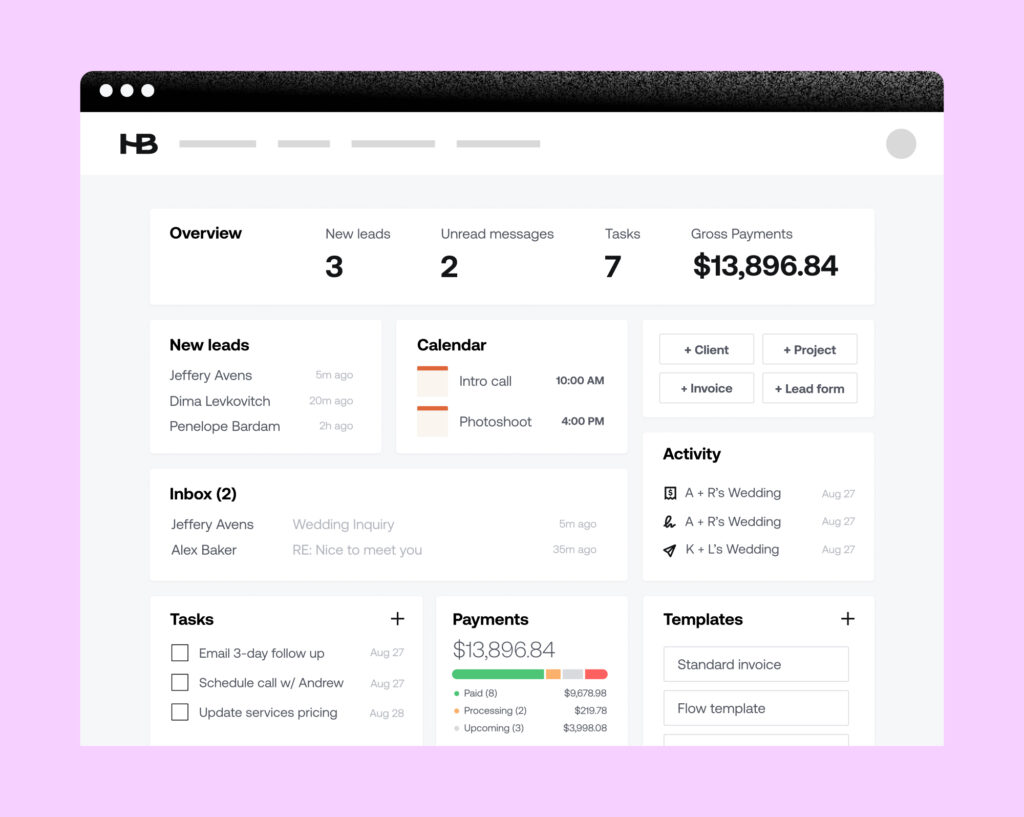
What HoneyBook Is
HoneyBook is a clientflow platform for independent business owners and small service teams. It combines lead capture forms, inquiry management, proposal and contract templates, scheduling, branded client portals, invoicing, payments, and lightweight CRM into a single subscription. The product is designed around a specific shape of business: one that sells a structured service engagement (a wedding shoot, an event design, a consulting package, a coaching program) and needs every client-facing moment to look professional.
HoneyBook was founded in 2013 and has built its customer base heavily in creative and event industries: wedding photographers, event planners, interior designers, brand consultants, life coaches, and similar service businesses. The platform is currently only available to business owners in the United States and Canada, which is a real constraint for anyone operating internationally.
The core pitch is that HoneyBook collapses the inquiry-to-booking-to-payment cycle into a single branded experience. A potential client fills out a lead form on your site, you respond with a templated proposal that includes pricing options, the client selects a package and signs a contract, pays a deposit, and lands in a client portal where the rest of the engagement plays out. Done well, this means a one-person studio looks and operates like an agency, and the client never feels like they are bouncing between four different tools.
Pricing
HoneyBook uses flat-rate pricing across three tiers, billed monthly or annually. Annual billing saves roughly 16 to 20 percent. The 2026 rates are Starter at $29/month annual ($36 monthly), Essentials at $49/month annual ($59 monthly), and Premium at $109/month annual ($129 monthly). Pricing can change, and HoneyBook runs frequent promotional discounts, so confirm current rates on the vendor’s site before subscribing.
The pricing structure matters because HoneyBook raised all plan prices significantly in February 2025. The Starter plan jumped roughly 89 percent (from $19 to $36 monthly), Essentials rose around 69 percent, and Premium rose around 63 percent. Long-time HoneyBook users have been vocal about the increase, and any review citing pre-2025 pricing is now outdated. Industry-wide SaaS price increases averaged 8 to 25 percent in this window, so HoneyBook’s hike sits at the upper end of that range, with the Starter plan well past it.
Starter at $29/month is positioned for solo operators and includes unlimited clients and projects, basic invoicing, proposals, contracts, scheduling, and the mobile app. It does not include automation, lead capture forms with conditional logic, or the more advanced AI features. For most working freelancers, Essentials at $49/month is the realistic baseline because that is where automation, branded client portal customization, two team members, and the AI features unlock. Premium at $109/month adds unlimited team members, priority support, multiple business profiles, and advanced reporting. The 30-day free trial does not require a credit card on the Starter plan, which is unusually generous for this category.
The pricing that the subscription does not include is payment processing. HoneyBook charges 2.9 percent plus $0.25 per credit card transaction and 1.5 percent on ACH bank transfers. On a $1,000 invoice paid by card, that is roughly $29.25 in fees. On $100,000 of annual revenue processed through HoneyBook on cards, that is around $2,925 in payment fees on top of the subscription. Premium users processing more than $500,000 annually may be eligible for negotiated card rates, but most subscribers will pay list. Encouraging clients to pay by ACH instead of card is one of the highest-leverage cost optimizations available.
Compared to direct competitors, HoneyBook sits in the mid-range. Bonsai uses per-user pricing that gets cheaper for solos and more expensive for teams. Dubsado costs around $40 monthly for a single user. FreshBooks at $33 monthly is cheaper and stronger on pure accounting but weaker on client experience. The right way to think about HoneyBook’s price is total annual cost including payment fees, not the headline subscription number.
Where HoneyBook Stands Out
Best-in-category client experience
HoneyBook’s interactive proposal, contract, and invoice combined into a single document is one of the slickest client-facing experiences in this entire software category. A client opens one link, sees the package options, selects a tier, e-signs the contract, and pays the deposit, all without bouncing between tabs or downloading PDFs. Reviewers consistently cite this as the single biggest reason they stay on HoneyBook even after the 2025 price increase. For service businesses where the booking experience is a meaningful part of the sale, this matters.
Automations that actually save hours
On the Essentials plan and above, HoneyBook’s automation engine handles email sequences, follow-up nudges, payment reminders, and workflow triggers based on project status. Set it up once, and HoneyBook chases late invoices, sends post-booking welcome emails, and reminds clients about upcoming sessions on a schedule. Late payments drop significantly for most users, and the awkward “just checking on that invoice” emails largely disappear. The automation builder is approachable enough that a non-technical user can configure useful sequences in an afternoon.
AI features that are genuinely useful
HoneyBook has added a real suite of AI features over the past 18 months: automatic meeting notes from client calls, AI-drafted email responses, daily action plans that surface the most important follow-ups, predictive alerts for high-value leads, and AI-assisted workflow builders. These are not vaporware bolt-ons; they have been built into the platform thoughtfully. The daily action plan in particular keeps small details from slipping through the cracks during busy seasons, which is a real operational improvement for solo operators.
Flat-rate pricing scales fairly
HoneyBook’s flat-rate pricing is structurally fairer than per-user pricing for growing teams. A three-person studio on Essentials pays $49/month total, not $147. The Premium plan supports unlimited team members at $109/month, which is the same price whether you have three users or fifteen. For service businesses that bring on assistants, second photographers, or contract collaborators, this pricing model is materially better than per-seat competitors.
Where HoneyBook Falls Short
The 2025 price increase is a real factor
HoneyBook raised Starter by 89 percent in early 2025, which is a substantial single-year increase even by SaaS standards. For freelancers who are not actively booking clients, the new pricing is harder to justify, and several long-time users have publicly migrated to Dubsado, Indy, or flat-rate alternatives. The product is still good; the question is whether the value-to-price ratio is good enough for your specific volume. A photographer booking ten weddings a year easily justifies $49/month. A consultant taking on two new clients per quarter has a harder case.
US and Canada only
HoneyBook is currently only available to business owners in the United States and Canada. UK, EU, Australian, and other international freelancers cannot subscribe regardless of how well the product would fit. HoneyBook has indicated international expansion is on the roadmap, but no timeline has been confirmed publicly. For international service businesses, Bonsai, Dubsado, and Indy are the practical alternatives.
Weak on time tracking and accounting
HoneyBook is not built for hourly billing. Time tracking exists but is rudimentary compared to Bonsai’s project-time-to-invoice automation. Accounting is similarly thin: HoneyBook handles invoicing and payments well, but real bookkeeping happens elsewhere. Most HoneyBook users integrate with QuickBooks for books, or export transaction data manually. If your business model is hourly consulting with detailed time reporting, HoneyBook is probably the wrong tool.
Team caps on lower tiers
The Starter plan does not support team members at all. Essentials supports up to two team members in the client portal. Only the Premium plan at $109/month unlocks unlimited team access. For a service business with even three people, the math forces a Premium upgrade that smaller competitors do not require.
Who Should Use HoneyBook
HoneyBook is a strong fit for creative service businesses with structured engagements: wedding and portrait photographers, event planners, interior designers, brand and graphic designers, videographers, and similar businesses where a client books a package and the engagement has a clear arc from inquiry to delivery. If your sales cycle starts with a contact form and ends with a final payment, HoneyBook is built for exactly that shape.
It is also a good fit for coaches, consultants, and small service agencies in the US and Canada whose revenue model is package-based rather than hourly. Anyone who sells “a six-week intensive” or “a brand identity engagement” or “a quarterly retainer” benefits from HoneyBook’s proposal-contract-payment flow. The branded client portal makes a one-person operation feel like a much bigger business.
It is not a strong fit for businesses outside the US and Canada, anyone whose billing model is primarily hourly with detailed time tracking, service businesses where accounting depth matters more than client experience, or pure product businesses with inventory. For hourly-billing freelancers, Bonsai is usually the better tool. For accounting-first freelancers, FreshBooks wins. For international service businesses, HoneyBook is simply not an option.
FAQ
How much does HoneyBook cost in 2026?
HoneyBook offers three plans. Starter is $29/month on annual billing or $36/month monthly. Essentials is $49/month annual or $59/month monthly. Premium is $109/month annual or $129/month monthly. Pricing went up in February 2025, so any older numbers cited elsewhere are outdated.
Is the HoneyBook free trial really 30 days?
HoneyBook advertises a 30-day free trial on its pricing page, with no credit card required on the Starter plan. Other sources cite 7 days, which appears to reflect older trial structures or specific promotional periods. Confirm the trial length on the current pricing page before signing up.
What are HoneyBook’s payment processing fees?
HoneyBook charges 2.9 percent plus $0.25 per credit card transaction and 1.5 percent on ACH bank transfers. These fees apply on top of the monthly subscription. For businesses processing $100,000 annually on cards, that adds roughly $2,925 in fees. Premium users transacting over $500,000 annually may be eligible for negotiated card rates.
Does HoneyBook work outside the US and Canada?
No. HoneyBook is currently only available to business owners with US or Canadian bank accounts. International expansion has been mentioned on the company’s roadmap, but no launch dates have been announced publicly. International service businesses need to consider Bonsai, Dubsado, or Indy instead.
How does HoneyBook compare to Bonsai?
Both serve service businesses, but with different emphases. HoneyBook leans toward inquiry intake, client communication, branded booking experience, and creative-industry workflows. Bonsai leans toward proposals, contracts, time tracking, and freelancer billing automation. HoneyBook uses flat-rate pricing; Bonsai uses per-user pricing. Wedding photographers and event planners typically choose HoneyBook. Designers, developers, and hourly consultants typically choose Bonsai.
Does HoneyBook do real accounting?
Not really. HoneyBook handles invoicing, payments, and basic income tracking, but it is not a substitute for QuickBooks, Xero, or FreshBooks for proper books. Most HoneyBook users either export transaction data to their accountant or integrate with QuickBooks for reconciliation.
Can I use HoneyBook for hourly billing?
Technically yes, but it is not what HoneyBook is built for. Time tracking exists but is basic. For service businesses where every project bills by the hour with detailed time reports, Bonsai or FreshBooks handles that workflow better. HoneyBook shines on fixed-fee engagements and package-based pricing.
What is HoneyBook’s referral program?
HoneyBook runs an active referral program. Current members can refer new subscribers using a unique link, offering the referred user a discount (typically 25 to 30 percent off the first year) and earning $50 to $200 per qualified referral after the new subscriber has been active for 100 business days. There is also an affiliate program for non-members with audiences in the creative business space.
How long is the HoneyBook contract?
There is no long-term contract. HoneyBook is month-to-month on monthly billing or annually prepaid on annual billing. Annual subscribers who cancel mid-year typically do not receive refunds for unused months, so be reasonably confident before committing annually.
Does HoneyBook integrate with QuickBooks?
Yes. HoneyBook offers a one-way QuickBooks Online integration that syncs invoices and payments to QuickBooks for accounting reconciliation. It is available on all paid plans. Other integrations include Google Calendar, Gmail, Zoom, and Zapier on the Essentials plan and higher.
Final Verdict
HoneyBook is the right answer for a specific shape of service business: one selling structured engagements to clients in the US or Canada, where the client experience from inquiry to final payment is a meaningful part of the sale. For wedding photographers, event planners, designers, and coaches with package-based pricing, HoneyBook’s interactive proposals and branded client portal genuinely differentiate the business and the math justifies the cost.
The 2025 price increase narrowed the case for very low-volume users. At $29/month for Starter and $49/month for Essentials, HoneyBook needs to be saving real time or enabling real revenue to be worth it. For a freelancer booking five or more clients a month, that case is easy. For someone testing the waters with two or three projects a year, a simpler tool or even a manual workflow may be the right answer until the volume justifies the investment.
The flat-rate pricing model is the strongest argument for HoneyBook over Bonsai for any team of three or more, and the proposal-to-payment experience is the strongest argument for HoneyBook over almost any pure accounting tool. Use the free trial with real client data before subscribing annually, and if you process meaningful card volume, model the total cost with payment fees included.
Related Reads
- Bonsai Review – The closest head-to-head. Stronger on time-billing and contracts, weaker on client communication.
- Indy Review – The international-friendly flat-rate alternative for service businesses outside the US and Canada.
- FreshBooks Review – Better choice when accounting matters more than the booking experience.
- QuickBooks Review – The accounting backend most HoneyBook users eventually integrate with for proper books.
This article is informational only and not legal, tax, or financial advice. Pricing, features, and product availability can change; verify current details on the vendor’s website before purchase. FirmTools is not affiliated with HoneyBook.
Last updated on May 25, 2026